 Breeds
Bedlington Terrier
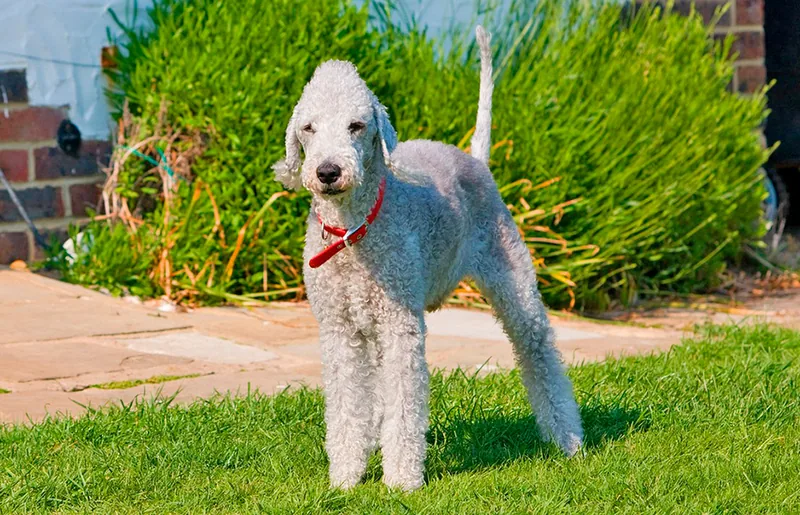
Despite looking similar to a sheep, the Bedlington Terrier is a very active, playful, affectionate dog. Ideal for family settings, including homes with children.
Among its traits, its coat color stands out, since, as strange as it sounds, it can sometimes be blue. Here at SoyUnPerro we bring you the complete rundown on this unusual breed.
Characteristics of the Bedlington Terrier
This is a medium-sized dog that tends to surprise people with its unusual look. An adult male measures 39 to 43 centimeters at the withers, and females 38 to 42 centimeters, with a weight ranging between 8 and 10.5 kilos.
Its body is vigorous and elegant, with long, muscular legs. It has a narrow, pear- or wedge-shaped head, covered by a curly, fluffy topknot, and a long jaw. Another curious fact: it's the only terrier with a curved body line.
This breed has large, well-defined nostrils, with a nose that can be black or brown. Its ears are oval and hang on both sides, with silky white fringes at the tip. At rest, its expression is sweet and kind, with small, bright, deep-set eyes.
As for the Bedlington Terrier's neck, it's long and deep at the base, with no dewlap. Its body is muscular and flexible, with a fairly wide chest and flat, sloping shoulders. The feet are long, with thick, compact pads.
The Bedlington Terrier's coat, which is thick and curly, can be blue, brown (liver), or sandy in color. It's usually a bit longer on the legs. Its coat is one of its main trademarks. Finally, its tail is thick at the base and tapers toward the tip. The Bedlington Terrier has an average lifespan of around 12 years.
What Is the Bedlington Terrier's Temperament Like?
The Bedlington Terrier loves doing sports and running around the yard, since it's a fairly active dog with naturally good muscle power.
Its sighthound bloodline also gives it a lot of quickness in its reactions. It adapts well to indoor living, but needs to go out for walks several times a day.
It's a very playful, affectionate, obedient breed, though it can sometimes be a bit stubborn. Overall, the Bedlington Terrier is an excellent companion that loves receiving all kinds of attention.
It usually gets along well with children, making it a good choice for families. If it needs to live with other dogs, it's best to socialize it from puppyhood so there are no issues.
With strangers, it tends to be initially reserved, watching from a distance until it gains enough confidence. On the other hand, you should avoid leaving it alone for long periods, since it won't develop properly otherwise.
Recommended Care for the Bedlington Terrier Breed
For a Bedlington Terrier to look the way we're used to seeing in photos, thorough grooming is important. How? By brushing it at least once a week and taking it to a groomer for its characteristic haircut.
This is a unique type of cut, which must be done with scissors and is quite complex. It's also important to follow the vaccination schedule recommended by the vet and take it in for regular check-ups to confirm it's in good health.
As for its diet, you should know it has trouble processing foods high in copper. Because of this, these shouldn't be part of its diet. High-quality kibble or natural dog food is recommended, what's known as BARF food. This way, your Bedlington Terrier is sure to stay healthy and happy for a long time.
History of the Breed
The Bedlington Terrier is a cross of Poodle, Whippet, and Dandie Dinmont Terrier. Despite this, it's considered one of Great Britain's oldest breeds.
By the 18th century, this breed was already established in the district of Bedlington, from which it takes its name. It was a dog that used to accompany English miners, since it was in charge of hunting rats in the mine shafts.
Like other terrier breeds, it was also used by hunters to chase badgers, hares, and foxes, thanks to its great agility and quickness.
By the late 19th century, English high society began taking an interest in it, and the Bedlington Terrier began to change physically, taking on a more sophisticated look.
It also crossed borders and began to have a presence in other countries such as the United States, Canada, Germany, France, and the Netherlands.
IMPORTANT: This article is for informational purposes only and does not constitute veterinary, nutritional or behavioural advice. Every dog is different, and only your trusted vet can advise you on its specific needs.