 Breeds
Russian Wolfhound (Borzoi): Elegance and Speed in a Unique Dog
The Borzoi, bred by the Tsarist aristocracy to hunt wolves on the steppe, is a breed that combines speed with cold tolerance. After the 1917 Revolution, only a handful of individuals managed to preserve the breed abroad, a fact that shaped its genetic history. This article explores his hunting legacy and how to understand his unique temperament.
Origins and history of the Borzoi
In Russian, "borzyi" means swift. That's where Borzoi comes from, the name by which this breed is known worldwide, though in Spain he's also called the Russian Wolfhound. Behind the name lie centuries of breeding directed by the Tsarist nobility, who needed a dog able to work on the steppes: open terrain, freezing wind and fast-running prey. The solution was crossing Asian sighthounds brought from the East — the Saluki, the Tazi, the exotic Afghan Hound — with thick-coated native dogs like the Laika. Speed from the east, cold tolerance from the north. The animal that emerged, sleek and capable of bringing down wolves in packs, took shape both physically and in temperament over generations.
The Perchino kennel, owned by the highest Russian nobility, went on to house hundreds of individuals with meticulously controlled bloodlines. Beyond his hunting effectiveness, the Borzoi was a symbol. All of that ended in 1917. The Russian Revolution swept the breed up with it: the new rulers linked him to the luxury of the overthrown class and ordered many dogs destroyed. Those who survived did so thanks to breeders who managed to get individuals out of the country in time, mainly to England and the United States. Today's entire Borzoi population comes from that small founding stock, and that genetic bottleneck lies behind part of the breed's sensitivity to certain conditions today.
The Borzoi belongs to the sighthound group, breeds who spot prey by sight and take off after it in explosive bursts, like the agile Cirneco dell'Etna and other breeds selected for coursing. Unlike scent hounds, these dogs make their own decisions during the chase, without waiting for direction from the hunter. That autonomy runs deep.
Physical characteristics of the Borzoi
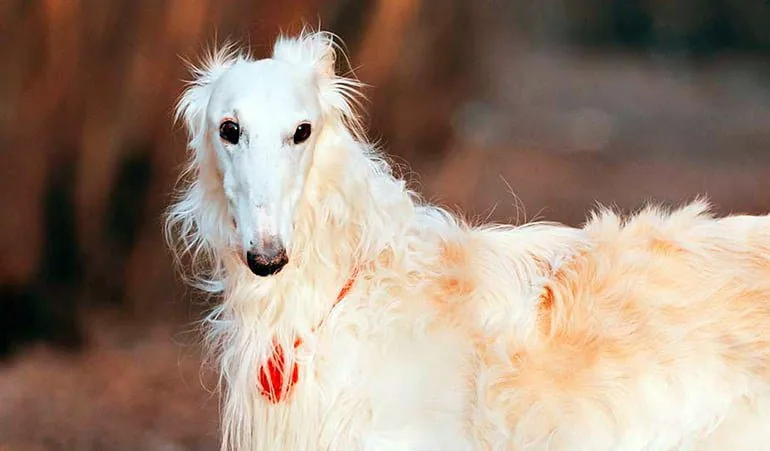
An adult male Borzoi stands between 75 and 85 cm at the withers; females fall between 68 and 78 cm, with weight ranging from 34 to 47 kg. They're among the tallest sighthounds there are. But the build is what really throws people off. The chest is deep yet narrow, the belly tucks up sharply, and the muscle lies flat against the skeleton, everything oriented toward cutting air resistance and stretching the stride to its limit. The long, tapered head, with a stop so subtle it's almost imperceptible, finishes off a silhouette that has more of a thoroughbred about it than an ordinary dog.
The coat says a lot about Russian steppe winters. The feathering falls on the neck, the back of the thighs and the tail; overall it's silky and wavy, medium length, and thickens considerably in cold weather. Accepted colours range from white to grey, taking in gold, red and brindle, with every combination possible, and a dark mask on the muzzle is common. Nose and eye rims must be black, except in diluted coats. The sabre-shaped tail hangs calmly at rest and rises during a run, where it acts as a rudder for the sharpest changes of direction.
Watching a Borzoi gallop up close changes your perspective. His is a suspended double-suspension gallop. All four legs leave the ground at two separate moments — one at full extension, one gathered under the body — producing an extraordinarily efficient stride for the energy it costs. That's why he can sustain high speeds longer than you'd expect. Long, straight legs, and that hare foot so prized in the breed, with arched, tightly closed toes, giving traction and stopping the dog from sinking into soft ground. The standard is unyielding on this point. Any hint of heaviness or coarseness is penalised as a serious fault, because it undoes exactly what this dog was created for.
Borzoi temperament and character
The Borzoi's temperament is a balance of contrasts that throws off anyone expecting an exclusively high-energy dog. At home he's calm, quiet and surprisingly gentle, able to spend hours stretched out on a sofa without demanding constant attention. This inner calm isn't apathy, but an energy economy inherited from his role as a hunter: on the steppe, periods of inactivity were as crucial as periods of pursuit. That serenity, however, switches off instantly the moment a visual stimulus triggers his prey drive. Cognitive independence is another central trait; bred to make autonomous decisions during the hunt, the Borzoi doesn't show the blind obedience of a herding dog, but cooperation conditional on the command making sense within his own mental framework.
With his family, the Borzoi builds a deep but restrained bond. He isn't an effusive dog who jumps and licks; instead he expresses affection through quiet closeness, unhurried eye contact and unwavering loyalty. This emotional reserve shouldn't be mistaken for coldness; his social language is simply more subtle. Around strangers, the typical attitude is polite distance: he watches, assesses and rarely turns aggressive, but he doesn't actively seek interaction either. That combination makes him a poor candidate as a guard dog, since he lacks the territoriality and reactivity that role requires.
Early socialisation is the factor that shapes how these instincts express themselves. A Borzoi exposed during his sensitive period to urban settings, noises, varied people and other dogs will develop the emotional stability to better manage the triggers behind his chase drive. Without that foundation, reactivity toward certain moving stimuli can require careful management. Habituation work needs to respect his sensitivity: coercive methods produce distrust and shutdown, while positive reinforcement builds an effective communication channel with a dog who, by nature, weighs every interaction.
With children, dogs and small animals
With children the relationship works, always with supervision. At home, the Borzoi is a mellow dog who handles children's noise and commotion without losing his cool. The problem comes when he takes off. A sudden gallop can knock a small child over without the dog meaning to, pure mass and speed. Kids need to learn to move calmly around him, without running or sudden gestures that trigger his chase reflex. If he's grown up with children from puppyhood, he ends up folding them into his circle without possessive behaviour.
With other dogs he does well. He has a preference for other sighthounds, like the slender Italian Greyhound, because with them play means chasing and racing rather than grappling. More physical breeds, like the hardy Spanish Greyhound, can cause misunderstandings if their play styles don't match, though with good socialisation it rarely goes beyond that. Cats, rabbits or guinea pigs are another story. They trigger something very deep in him, a prey drive that's very hard to inhibit. Some Borzois end up living peacefully with the family cat, but that requires a very gradual introduction, constant supervision, and accepting the risk never drops to zero.
In multi-species households, everything comes down to managing the environment well. Physical separation whenever nobody's watching. Visual barriers so the dog can't fix his gaze on the small animal. And a controlled outlet for his need to run — lure coursing fits perfectly here. Anyone expecting a sighthound to completely ignore anything that moves fast doesn't understand how deeply artificial selection has shaped his brain.
Diet and nutrition by life stage
The Borzoi's diet needs to be adjusted to his metabolism and chest anatomy. During puppyhood, the goal is slow, even growth that allows proper bone and joint development. Excess energy or calcium at this stage can speed up the closure of the growth plates and favour dysplasia or angular deformities, problems especially serious in a breed with such long legs. Kibble formulated for large breeds is recommended, with controlled protein and fat levels suited to his needs, split into three or four meals a day up to six months. Weight should be monitored weekly: the ribs should be palpable under a thin layer of fat, but never visible from a distance.
In adulthood, the priority is maintaining lean muscle mass without encouraging obesity, which would overload his joints and worsen the risk of gastric torsion. A diet with highly digestible protein (around 22-24%) and moderate fat (10-12%) is usually appropriate, always adjusted to the dog's actual activity level. A Borzoi competing in lure coursing or running regularly needs a higher calorie intake, but it needs to come in meals separate from intense exercise. Gastric dilatation-volvulus is a potentially fatal emergency in deep-chested breeds, and prevention means offering two or three meals a day rather than one large ration, avoiding rapid eating with anti-gulping bowls, and banning vigorous exercise for two hours after a meal.
In the senior stage, from around seven or eight years old, metabolism slows and muscle mass tends to decline. The formula should be enriched with high-biological-value protein to slow sarcopenia, while fat is scaled down if the dog's activity level drops. Omega-3 fatty acids, from fish oil, support joint health and cognitive function. Hydration becomes especially important, since older dogs tend to drink less; wet food or adding warm water to dry kibble can encourage intake. Any change in appetite, stool consistency or weight should prompt a vet visit to rule out underlying conditions before changing the diet on your own.
Exercise and stimulation: running, walks and lure coursing
The Borzoi isn't a dog who settles for short walks around the block. His exercise needs combine two distinct components: low-impact daily aerobic activity and periodic free-running sessions in safe spaces. Lead walks, at least an hour a day split across two or three outings, cover scent exploration, environmental socialisation and maintaining a basic muscle tone. However, these walks don't satisfy his core need to gallop. For that, a fence at least 1.8 metres high is essential, since his jumping ability is remarkable and a lower fence poses an escape risk at any stimulus that triggers his chase instinct.
Lure coursing — chasing a mechanical lure that mimics a hare's path — is the activity that best replicates his original function and gives the most complete physical and mental stimulation. During a session, the dog unleashes his suspended gallop, makes tight turns and experiences the satisfaction of completing a simulated hunting sequence. This practice not only channels his prey drive in a controlled way, but strengthens the specific muscles used in galloping and prevents behavioural problems that stem from frustration. Sighthound clubs organise training and competitions adapted to different levels, and regular participation builds a cooperative bond with the handler that goes beyond mere obedience.
Mental stimulation shouldn't be neglected either. The Borzoi, despite his reputation as an independent dog, needs cognitive challenges that respect his learning style. Scent games — hiding treats around the house or garden — tap into an ability often underestimated in sighthounds. Clicker training and free shaping let you teach complex behaviours without generating the resistance that repetitive commands produce. The key is offering short, varied sessions with a high reinforcement rate, letting go of any expectation of mechanical obedience. A mentally satisfied Borzoi is a dog who genuinely relaxes at home, without resorting to substitute behaviours like compulsive licking or nervous pacing.
Grooming, hygiene and where the Borzoi lives best
The Borzoi's striking coat doesn't make him a maintenance headache. Running a long-pin comb and a soft-bristle brush over him once a week is enough to remove dead hair and spread the oils that give the coat its life. During shedding, that changes: frequency needs to go up to two or three sessions a week to keep hair loss under control. The feathered areas — neck, thighs and tail — are the first to tangle, so checking them after any walk in the countryside is worthwhile, since seeds and plant debris catch there with remarkable ease. Bathing should be kept to the bare minimum; washing him too often destroys the oily layer that waterproofs the coat and gives it that characteristic shine.
Nails and teeth need regular attention. In sighthounds tartar builds up fairly quickly, and slowing it down means brushing the teeth at least three times a week with an enzymatic toothpaste specific to dogs. Nails can't be trusted to natural wear, even in active dogs walking on hard surfaces; if they grow too long, they change how the paw makes contact with the ground and put more strain on the joints than they should. A monthly trim avoids that problem. Ears are cleaned every two weeks with gauze dampened in an ear cleaner, or sooner if there's visible build-up. Watch out for this: getting the puppy used to all these routines from the start, calmly and with positive reinforcement, is the difference between a dog who cooperates and one who vanishes every time the toothbrush appears.
The Borzoi has little subcutaneous fat and fairly thin skin. That takes a toll if he regularly rests on hard floors, since elbows and hocks can fairly easily develop calluses. An orthopaedic mattress or thick blankets in his favourite resting spots is a small investment his joints will thank you for in the years ahead. He can adapt well to a flat as long as he gets out to move every day, but ideally he has access to a well-fenced garden where he can let loose a real gallop. Cold isn't a problem, his coat protects him well. Heat is another matter: in summer he needs cool areas, water always available, and exercise during the hours with least sun.
Borzoi health and hereditary diseases
Sighthounds in general, and the Borzoi in particular, metabolise anaesthesia differently from other breeds. His long body with little fat alters the pharmacokinetics of certain anaesthetic agents, prolonging their effect longer than expected and turning intraoperative hypothermia into a real risk. On top of that, they're highly-strung dogs, and stress can raise their temperature even before they enter the operating theatre. These particularities were documented in ‘Anesthesia of the sighthound’ (1999). Any procedure requiring sedation needs to be in the hands of someone experienced with sighthounds, with adapted protocols — benzodiazepine premedication to lower anxiety, fast-clearance induction agents — and temperature monitored throughout.
Of the conditions with a genetic component, the most dangerous is gastric dilatation-volvulus. The deep chest and the laxity of the ligaments that hold the stomach in place predispose the organ to twist on its axis, cutting off blood supply and triggering shock within hours. A markedly swollen abdomen, unproductive retching, restlessness that won't settle: if those three signs appear, there's no time to lose. On the cardiac front, dilated cardiomyopathy has also been documented in the breed, though with lower incidence than in the Irish Wolfhound. An annual echocardiogram from age five onward catches early changes and allows treatment to start before the dog shows clinical signs.
There are two other fronts worth keeping in mind. On the eye side, multifocal chorioretinopathy lesions were identified in individuals in western Canada, a condition whose relationship to progressive retinal atrophy is still under investigation, as documented in ‘Multifocal chorioretinal lesions in Borzoi dogs’ (2005). Rigorous breeders include eye fundus exams in their selection protocols. On the respiratory side, sighthounds show a higher prevalence of pulmonary interstitial emphysema and spontaneous pneumomediastinum — air present in lung tissue and the mediastinum with no prior trauma — than other breeds undergoing chest CT scans, according to ‘Pulmonary interstitial emphysema and spontaneous pneumomediastinum are more…’ (2024). Many cases resolve with rest, but it's worth assessing with the vet to rule out complications. The Borzoi's life expectancy runs between 9 and 14 years, a range that depends heavily on genetics, diet and preventive care. As a member of FCI Group 10, he needs fenced spaces enclosed to at least 1.8 metres in height.
Seeing a Borzoi in motion is more convincing than any description. A day of lure coursing, a visit to a sighthound club, a chat with breeders who put health and temperament ahead of aesthetic trophies: all of that helps make sense of what lies behind that calm bearing. These are dogs who've spent centuries on the steppe, and that doesn't disappear just because they now live in a city flat.
IMPORTANT: This article is for informational purposes only and does not constitute veterinary, nutritional or behavioural advice. Every dog is different, and only your trusted vet can advise you on its specific needs.