 Breeds
Dalmatian: Temperament, Care and Fun Facts
The Dalmatian, an icon among firefighters, carries a past as a carriage dog that explains his boundless energy. Puppies are born completely white and their spots develop gradually over the first weeks. His history, athletic build and temperament reveal what makes this dog unique.
Origins and history: from carriage dog to firefighting icon
The Dalmatian's exact origin remains a puzzle that divides dog-history experts. Depictions of spotted dogs appear in Egyptian frescoes, Greek pottery and Italian Renaissance paintings, but the breed as we know it today came together in England during the 18th century. His name refers to Dalmatia, a coastal region of present-day Croatia, though there's no conclusive proof the breed actually originated there. What is documented is his role as a carriage dog: he trotted tirelessly alongside horse-drawn coaches, clearing the way, protecting the horses from other dogs such as the Spanish Greyhound and deterring would-be attackers. That job called for extraordinary physical stamina and a natural affinity with horses, two traits the Dalmatian still carries in his genes.
The link with firefighters comes from that same tradition. In 19th-century British and American cities, fire engines were horse-drawn, and Dalmatians ran ahead to clear a path through traffic and calm the horses amid the chaos. When motorised vehicles replaced the horses, the bond was already so strong that many fire stations kept these dogs as mascots and symbols of protection. Today the Dalmatian is still the living image of fire departments in many countries, a legacy that speaks to his courage, intelligence and ability to work in demanding environments.
Beyond the romantic myth, the Dalmatian's history reveals a dog selected for constant action. He wasn't just an aristocratic ornament: his job called for independence, alertness and an efficient stride. That functional heritage explains why the modern Dalmatian needs far more than a daily walk to feel fulfilled, and why his balanced temperament depends on channelling that energy constructively.
Measurements and physical appearance
Some breeds make an impression through size. The Dalmatian makes his through symmetry. Medium-large body, visible but not exaggerated muscle, clean lines and a bearing people notice the moment he walks by. Males stand 56 to 61 cm at the withers; females, 54 to 59 cm. Weight runs around 25–32 kg in males and 20–27 kg in females, though those figures mean little without proper body condition to go with them. The silhouette is square or slightly rectangular: deep chest, well-sprung ribs, tucked-up abdomen. A dog built to cover kilometres, not for photos. A long, whip-like tail and high-set ears that lie close to the head with an almost silky texture.
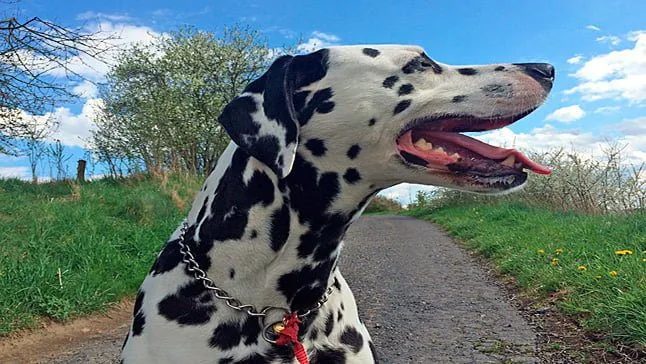
The coat is short, smooth, dense and glossy. It repels dirt fairly well and dries fast, something anyone who walks the dog in the rain will appreciate. But what really defines the breed is the spots, and here's the twist: puppies are born completely white. Not a single spot. Spotting begins to appear around the second or third week of life and keeps developing over the first few months. The nose and eye rims follow the same colour code as the spots: black in black-spotted individuals, liver brown in liver-spotted ones.
The expression is lively and intelligent, with round, medium-sized eyes that convey a lot of presence. The overall look needs to suggest agility and stamina; any hint of coarseness no longer fits the type. Watch out for this: when a Dalmatian shows nervous hypersensitivity or apathy, the cause almost always lies in poor breeding or a lack of stimulation, not in his build.
Colours and spotting patterns
The official standard recognises two colour varieties: the black Dalmatian (black spots on pure white) and the liver Dalmatian (liver-brown spots on white). Both are equally valid in competition, though black is more common in breeding lines. Ideal spots are round, crisp, well-separated and proportionate in size. They spread across the whole body, including the legs and tail, and tend to be smaller on the head and ears. Spotting that's too merged, forming large patches, is considered a fault against the beauty standard.
Other colours exist that aren't accepted, resulting from recessive genes or historical crosses. The lemon Dalmatian shows pale yellow or light orange spots; the blue Dalmatian shows bluish-grey spots; and there are brindle or tricolour individuals, with combinations of black, tan and white. These colours aren't desirable in responsible breeding because they're often linked to skin pigmentation problems, similar to those in the albino Doberman, or to a higher incidence of deafness. The genetic basis for the spotting lies in the piebald gene, the same one that produces the spotted pattern in other breeds, but in the Dalmatian it expresses itself with an almost mathematical precision that breeders have refined over generations.
Temperament: a dog who demands to be at the centre of everything
If you're looking for a dog who'll lie on the sofa and leave you in peace, the Dalmatian isn't for you. He's an active, loyal animal who needs to be part of what's going on at home at all hours. When left alone for too long, anxiety creeps in. It isn't bad luck or poor upbringing; it's part of how he's built. His intelligence lets him learn fast, but that same trait also makes him bore easily, and when he gets bored, the upholstery notices.
Living with a Dalmatian has its rewards. He's a cheerful dog who bonds with the whole family, children included — though supervision with them is always wise — and who fits well into disciplines like agility, canicross or advanced obedience. The less appealing side includes the daily demand for real exercise, a tendency to become destructive when ignored, a certain predisposition to health issues worth knowing about beforehand, and a shed many people discover too late. The short coat is deceiving. He sheds a lot.
With strangers he tends to be affable, though the first few minutes he may seem a bit distant. He comes from guardian stock — he watched over carriages — and some of that initial reserve has stuck in his character. He doesn't look for trouble, but his size and energy can overwhelm other dogs if nobody teaches him to read the room. Early, varied and consistent socialisation is what separates a Dalmatian who fits into any situation from one who causes problems at every park.
The idea that the Dalmatian is aggressive circulates quite a bit, driven largely by how he's been portrayed in film and television. From a behavioural standpoint, that label doesn't hold up. As with the Great Dane or any other breed, aggression depends on individual genetics, how the animal was socialised, the treatment it's received, its health, and the situations it's been through. Raise a Dalmatian with positive reinforcement, socialise him well and meet his needs, and you'll have a conflict-free dog.
His origin as a guard dog left him with a clear tendency to stay alert and be wary of the unfamiliar. Properly channelled, that trait produces a watchful but stable animal. Real problems start when several factors pile up at once: lack of socialisation, punishment, isolation or undetected chronic pain. A Dalmatian who doesn't know how to handle frustration, or who's carrying something undiagnosed — urinary stones, deafness — can react with growling or biting. Watch out for this, because the cause isn't in the breed.
Prevention has more to do with routine than magic. Structured socialisation from the first weeks, gradual exposure to stimuli, respectful handling and vet check-ups that rule out hidden pain. And learning to read the dog, who also communicates. A Dalmatian who licks his lips, turns his head or goes rigid is saying he's uncomfortable. Forcing contact at that moment is the most direct way to trigger a defensive response.
Exercise and mental stimulation: keys to a balanced Dalmatian
The Dalmatian was shaped by artificial selection to trot for hours alongside horses at a trot or gallop. That physiological legacy translates into a minimum requirement of two hours of exercise a day, which can't be limited to a lead walk down the pavement. Exercise needs to include periods of intense aerobic activity: running free in a safe space, canicross sessions, controlled cycling or fetch games involving bursts of speed and changes of direction. Without this physical outlet, pent-up energy turns into unwanted behaviours such as destructive chewing, excessive barking, hyperactivity indoors or chasing shadows and lights.
As important as physical exercise is mental stimulation. The Dalmatian is an intelligent dog who needs to solve problems to feel satisfied. Scent games — hiding treats around the house or garden — interactive puzzles, advanced obedience training or learning new tricks are tools that tire him mentally and strengthen the bond with his owner. Sports like agility or rally obedience combine exercise and focus, and suit this breed particularly well. A routine that alternates days of intense physical work with cognitive enrichment sessions prevents chronic boredom, one of the main triggers of behavioural problems in Dalmatians.
A common mistake is assuming a big garden replaces active interaction. The Dalmatian doesn't exercise himself; he needs his person's company and direction. Walks should vary in route and stimuli, and it's worth including moments of controlled socialisation with other dogs. Consistency in the exercise routine doesn't just shape the body — it regulates the dog's emotional state, reducing reactivity and fostering a calm temperament at home.
Low-purine diet and urinary health in the Dalmatian
Hyperuricosuria defines the Dalmatian in health terms perhaps more than any other trait. An autosomal recessive defect causes the body to excrete abnormally high amounts of uric acid through the urine, and urate stones are the most common result “Urate urolithiasis” (2009). The root of the problem is in the liver and the renal proximal tubules, which handle uric acid less efficiently than needed, pushing its levels up in blood and urine “Mutations in the SLC2A9 gene cause hyperuricosuria and hyperuricemia in the…” (2008). With concentrated urine or an acidic pH, that uric acid precipitates and forms crystals which, if they progress, become stones capable of blocking the urinary tract. A blockage always hurts. In males, the anatomy of the urethra makes complications more likely.
The response involves controlling purines in the diet. These are the compounds the body converts into uric acid, so cutting them from the plate is the most direct approach. Organ meats — liver, kidney, brain — are left out of the diet, since they concentrate purines in very high amounts. The same goes for oily fish, especially sardines, anchovies and mackerel. It's also best not to overdo red meat or add brewer's yeast as a supplement. Egg, low-fat dairy and some white meats cover protein needs without spiking the purine load. And water, plenty of it. Diluted urine is the most effective shield against crystal formation. Quite a few vets prescribe kibble formulated specifically for Dalmatians or for preventing urate urolithiasis, capable of slightly alkalinising the urine and keeping uric acid precursors in check.
The urinary front gets a lot of attention, rightly so, but the Dalmatian has other issues to watch. Congenital deafness is one of them and deserves its own section — covered further below. Skin allergies with atopic dermatitis also show up fairly often in the breed. And hip dysplasia, that old acquaintance of medium and large dogs, doesn't spare the Dalmatian either. Anyone who controls what the dog eats, gives him fresh water often and pays attention to how he urinates has a big head start against urolithiasis.
Congenital deafness: the BAER test and how to adapt training
Up to 30% of Dalmatians are born with congenital sensorineural deafness, making this hereditary condition one of the most common in the breed. Cases of total bilateral deafness are the hardest to manage, and many of these dogs end up euthanised because most households aren't prepared “De-novo and genome-wide meta-analyses identify a risk haplotype for congenital…” (2022). The outer and middle ear are perfectly normal. The fault lies in the cochlea, which loses its blood supply between 3 and 4 weeks of age, right when the auditory system should be finishing its maturation “Congenital deafness and its recognition” (1999). The hair cells of the organ of Corti die and the damage is irreversible.
The BAER test (Brainstem Auditory Evoked Response) is the gold-standard test for diagnosing this condition. It records the brainstem's electrical activity in response to sound stimuli and can be carried out from 5–6 weeks of age. Its big advantage is that it also picks up unilateral deafness, the kind that goes completely unnoticed in daily life but rules the animal out of responsible breeding. A serious breeder tests the whole litter before handing over the puppies and never breeds an individual with compromised hearing. Those who pass the test with both ears working well are called bilateral hearing.
Living with a deaf Dalmatian means completely changing the way you communicate. The voice stops being useful, and you work instead with hand signals for basic commands, a torch to catch his attention from a distance, and a vibration collar — never a shock collar — as an alert signal. The bond becomes even more decisive than with a hearing dog, because the animal relies on eye contact and touch to orient himself and feel safe. Consistent hand signals, a predictable environment and, mind you, plenty of patience do the rest. With method and consistency, a deaf Dalmatian can compete in dog sports, live with other dogs without issues, and maintain a deeply communicative relationship with his family.
Anyone looking to bring a Dalmatian into their life is taking on a dog with high physical and emotional demands who repays the effort with a loyalty hard to match. Before taking the step, it's worth understanding his exercise, diet and hearing-health needs well, and finding a breeder who works with the BAER test and genuine animal welfare standards.
With a Dalmatian at home, structured daily exercise isn't negotiable. A minimum of two hours a day combining running, scent work and obedience. Diet also needs attention, since the breed is prone to urinary stones and any excess comes at a cost. Routine vet check-ups should cover both hearing and kidney function. A balanced dog in this breed comes from a predictable routine, early socialisation and ongoing positive reinforcement — not from the clichés about his stubborn or difficult character.
IMPORTANT: This article is for informational purposes only and does not constitute veterinary, nutritional or behavioural advice. Every dog is different, and only your trusted vet can advise you on its specific needs.