 Breeds
All the Dog Breeds With a Blue Tongue
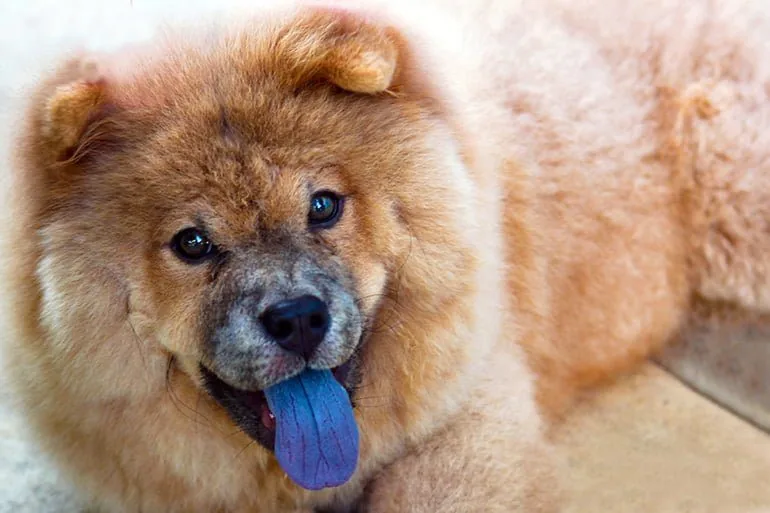
In the past, this strange coloring was chalked up to mythology, but today science gives us the explanation for why some dog breeds have a blue tongue. Keep in mind this trait shouldn't be confused with the disease known as "purple tongue."
Let's take a look at the only breeds that have this curious blue coloring on their tongue, and which other breeds only show a similar coloring in some individuals. Ready?
Why Do Some Dogs Have a Blue Tongue?
In certain breeds, this comes from a genetic mutation that turns a dog's typically pinkish tongue dark, blue, or bluish. It isn't known for certain whether this mutation stems from an issue in the breed's crossbreeding or from an adaptive (evolutionary) mutation.
But that's not the only theory scientists are considering — science also points to this curious coloring possibly being caused by excess production of melanin. Melanin is the substance responsible for pigmenting skin and coat.
Breeds With a Blue Tongue
Despite what some pet websites might have you believe... the truth is that only two breeds on the entire planet have a blue tongue. And curiously, both come from China.
- Chow Chow
- Shar Pei
The tongue of these breeds can be entirely blue-tinted or just show a few bluish patches. The intensity of this color on their tongue isn't a mark of purebred status — it's simply a curiosity.
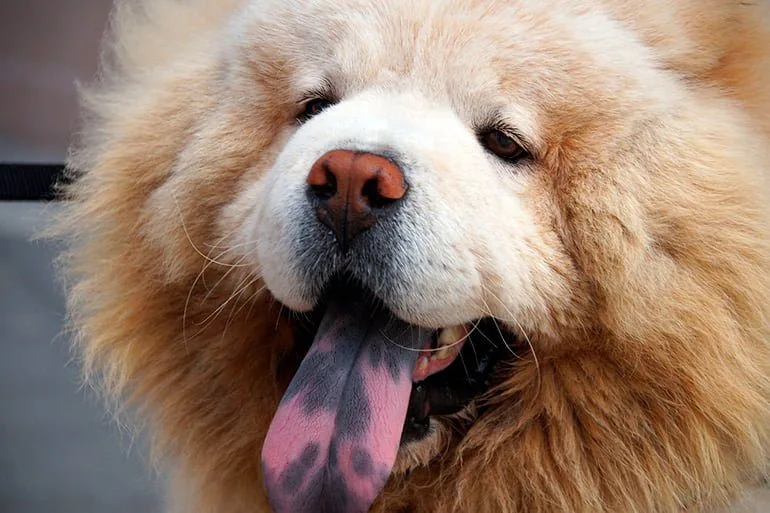
The Chow Chow
This curious breed from China is also known as the "Panda dog," because of its distinctive mane. It's not a very sociable breed and can be somewhat aggressive at times if not properly trained.
It's a large breed with a territorial streak. The Chow Chow is known for being quite stubborn, which also makes training somewhat challenging. For these reasons, this breed isn't recommended for inexperienced owners.
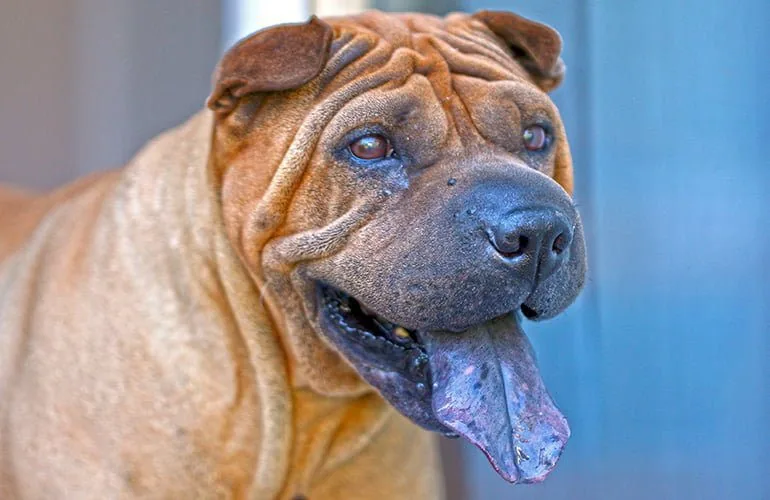
The Shar Pei
Known worldwide for its beautiful wrinkles, this breed is also somewhat stubborn when it comes to learning, but much more tolerant with its family, around whom it feels comfortable and will defend, since it's also an excellent guard dog.
The Shar Pei is also a large breed and comes from China, though there's also an American version that's somewhat smaller and considerably more wrinkled. They're known as "sandpaper-skin" dogs, since their skin is very sensitive.
Do All Individuals Have a Blue Tongue?
No — actually, only some individuals within these breeds have this curious blue tone. Other individuals of the same breed, also holding pedigree certification proving their purebred status, have a pink tongue.
Other Breeds With Blue Spots
There are other breeds where only some individuals may show similar pigmentation on their tongue. And although the spots are usually dark or black, there have also been cases of dogs with blue pigmentation.
Generally speaking, these breeds have a pink or pinkish tongue, but there are some exceptional cases. These are those breeds:
- Akita
- Doberman
- Australian Shepherd
- Pomeranian
- Dalmatian
Is the Blue Color a Health Problem?
The truth is, when a dog isn't getting enough oxygen while breathing, their gums and tongue start to darken, sometimes turning a bluish color — a sign that the dog is unwell and needs urgent veterinary attention.
We shouldn't confuse the color these breeds naturally show on their tongue due to a genetic mutation with the color of a sick dog who's struggling to breathe. Remember, only two breeds have this curious bluish pigmentation on their tongues.
IMPORTANT: This article is for informational purposes only and does not constitute veterinary, nutritional or behavioural advice. Every dog is different, and only your trusted vet can advise you on its specific needs.