 Breeds
Shar Pei: Everything About the Wrinkly-Skinned Dog
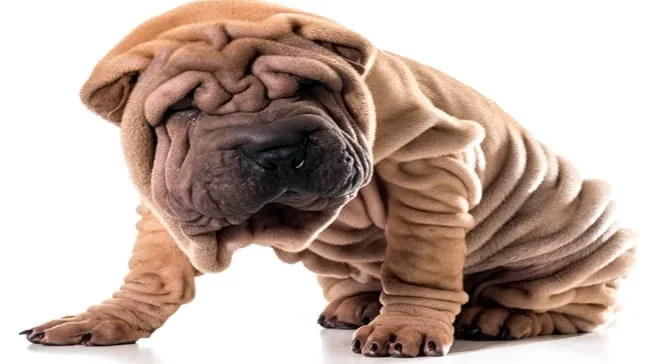
The Shar Pei, with his unmistakable wrinkled skin and blue-black tongue, is far more than a famous internet face: his origins trace back to China's Han dynasties, and today two genetic lines coexist — the traditional 'bone-mouth' and the extreme 'meat-mouth' — which radically shape his health and temperament.
History and origin of the Shar Pei
A breed that came close to total disappearance and still demands a lot from those who choose it today. Understanding where he comes from changes quite a bit how you live with him.
Two thousand years of history. The Shar Pei already appears in Han-dynasty China, bred in Guangdong province by farmers and fishermen who used him as a guard dog, a herder and, when the occasion called for it, a fighting dog. In Cantonese, the name roughly means "sand skin", which is exactly what it feels like to the touch. Along with the Shiba Inu, he's among the ancient breeds with the strongest documented presence still existing today. The loose folds of skin that draw so much attention weren't a morphological whim: during a fight, if the opponent sank its teeth in, the Shar Pei could twist within his own skin and counterattack without the bite reaching vital areas.
Disaster arrived with the People's Republic of China. Taxes on dog ownership and campaigns branding them a symbol of bourgeois decadence left the breed with almost no individuals. In the 1970s, Hong Kong breeder Matgo Law issued an urgent appeal through the international press to rescue what remained. The United States responded with resources and will, and the emergency breeding programme that started then is the direct origin of the modern Shar Pei. The problem with that race-against-the-clock rescue is that today's entire breed descends from a very small gene pool, something that has profoundly shaped both his health and his morphology.
Popularisation in the West during the 1980s opened a rift between two very different selection criteria. In China, breeders kept favouring an athletic, functional type; in the United States, breeders went after the most exaggerated folds, that "eternal puppy" face that drew so much attention. The two lines coexist today and carry noticeable differences in health, temperament and morphology. Watch out for this if you're looking for a puppy.
Physical differences between the traditional bone-mouth Shar Pei and the American meat-mouth
The Shar Pei isn't a single-mould breed. There are two breeding lines with such different builds that, placed side by side, it's hard to believe they share the same standard. The Chinese line, called "bone-mouth", produces dogs with a moderately wide muzzle, fleshy lips without going to excess, and folds concentrated mainly on the head, withers and tail area. A functional, agile animal that breathes well and doesn't carry the skin problems that plague the breed. The American "meat-mouth" has a narrower, drier muzzle, a less voluminous head, and folded skin that persists over the whole body into adulthood, traits selected on purpose to satisfy the Western pet market's taste for extreme looks.
Where both lines agree is on the blue-black tongue, one of those primitive traits shared by only a handful of breeds worldwide, the Chow Chow among them. Also the small, triangular, high-set ears, and that tail — thick at the base, tapering off, and ending curled over the back or hanging to one side. The FCI has a single official standard, but any experienced breeder can tell a traditional-type individual from an extreme-line one at a glance. And watch out for this if you're thinking of getting a puppy: meat-mouth dogs accumulate considerably more skin problems and breathing difficulties, and are more prone to entropion, an inward rolling of the eyelid that chronically irritates the cornea.
As for size, both lines fall within similar ranges, between 44 and 51 centimetres at the withers, with weight that varies quite a bit depending on the individual and his genetics. The coat comes in three types. The shortest and coarsest is the horse coat. Somewhat longer is the brush coat. And then there's the bear coat, the softest and densest of the three, which doesn't appear in the official standard though it shows up fairly often. Skin pigmentation needs to be uniform and consistent with the coat colour, a wide range of solid shades running from cream to black, taking in red, fawn, blue and isabella along the way.
Shar Pei temperament and character
The Shar Pei has an independent, reserved temperament and is deeply loyal to his family unit. His personality doesn't fit the stereotype of the effusive dog constantly seeking interaction; he's more like a silent guardian who watches, assesses and acts decisively when he perceives a threat. This watchful nature is rooted in centuries of selection as a guard and protection dog in Chinese villages, where he had to tell regular visitors from strangers on his own, without relying on constant commands. Anyone living with a Shar Pei often describes a mix of feline dignity and canine loyalty: a dog that doesn't seek to please at all costs, but who forms intense, exclusive bonds with his own people.
The question of whether the Shar Pei is aggressive calls for a nuanced answer. He's not an aggressive breed by nature, but he is reactive and territorial if his socialisation hasn't been properly worked on. His innate wariness of the unfamiliar, combined with a low tolerance threshold for invasions of his personal space, can lead to defensive behaviour if the dog feels cornered or hasn't learned to handle encounters with strangers. This tendency isn't pathological — it's an expression of his heritage as a guard dog. The Shar Pei rarely seeks conflict, but he doesn't shy away from it either if he perceives a real threat. That's why responsible ownership means understanding that aggression isn't a fixed personality trait, but a response that can be shaped through early, consistent, quality socialisation.
At home, a properly socialised Shar Pei is calm, clean and surprisingly adaptable to indoor living. Like the Spanish Greyhound, he isn't an overly attention-demanding dog, but he suffers from prolonged isolation and can develop destructive behaviour or separation anxiety if left alone for many hours without prior preparation. With children in the family he tends to be patient and protective, provided he's been taught boundaries and the interaction is supervised. With other dogs, especially of the same sex, he can show intolerance and dominance, a trait that calls for extra caution in parks and public spaces. He's not a dog for first-time owners looking for an extremely sociable animal; he's a companion for people who value loyalty over effusiveness and are willing to put time into his training.
Training and socialisation: the Shar Pei's temperament calls for its own approach
The Shar Pei learns well, but on his own terms. Coercive methods and exercises repeated to the point of boredom don't work on him because his mind works differently: he looks for the point of what's being asked before doing it. If the session drags on or turns routine, he switches off. Five to ten minutes, several times a day, with basic commands like recall, stay and drop it. Three things that make all the difference out on the street.
Between three and sixteen weeks of age, the puppy has a window that doesn't open again. During that time, a Shar Pei needs to meet different people, balanced dogs, city noises, varied surfaces. Calmly and positively, without overloading him. One bad encounter that triggers fear can do as much damage as a total lack of socialisation. The problem with this breed is that a puppy without that exposure has a high chance of becoming reactive toward strangers and other dogs in adulthood, and fixing that later is considerably harder than preventing it. Past four months, varied outings and controlled contact need to continue throughout his whole life.
There's something people often neglect that causes plenty of headaches later. The Shar Pei needs to be handled regularly — folds, ears, eyes, mouth, paws — because his anatomy demands it, and skin care along with eye monitoring are part of the weekly routine. A puppy who doesn't learn to tolerate that contact can turn a simple vet check-up into a standoff. The solution is pairing every touch with something the dog values highly, starting with very brief sessions — a few seconds — that get longer as the animal relaxes. A dog used to that from puppyhood makes home care simpler and turns vet visits into something manageable.
Health and life expectancy: Shar Pei fever, pyoderma and other hereditary diseases
Between 8 and 12 years. That's the Shar Pei's life expectancy, and the range is so wide because the breed carries a considerable genetic burden. The most serious and breed-specific condition is familial fever syndrome, also called Shar Pei fever, a hereditary autoinflammatory disorder that appears without warning with a high fever — often above 40°C — swollen, painful joints and hock swelling. Each episode usually resolves in 12 to 48 hours, but the real problem comes afterward. When episodes recur frequently, the body builds up abnormal protein in the kidneys — renal amyloidosis — which leads to chronic kidney failure. That's one of the leading causes of premature death in the breed. At any fever with no obvious cause, go to the vet as an emergency; no medication without a prior diagnosis.
The Shar Pei's characteristic folds come at a price. Inside those wrinkles a warm, damp microclimate forms where bacteria proliferate easily, and combined with a genetically compromised skin barrier and a local immune response that frequently falls short, the result is pyoderma — bacterial infections that present with redness, an unpleasant smell, discharge and itching. Left untreated, they become chronic. Cleaning the folds every week is necessary but not enough; diet, stress management and catching flare-ups before they escalate matter just as much. Also linked to the breed's genetics is idiopathic mucinosis, an excessive build-up of mucin in the dermis that's directly responsible for those unmistakable wrinkles. In dogs with pathological degrees of it, that mucin produces vesicles and skin fragility.
The Shar Pei has a high prevalence of vitamin B12 deficiency — hypocobalaminaemia, in clinical terms — which presents with diarrhoea, vomiting and weight loss, symptoms typical of a serious, prolonged gastrointestinal disease “Inflammatory, immunological, and intestinal disease biomarkers in Chinese Shar-Pei…” (2015). Many cases go underdiagnosed for years because the symptoms point toward other problems, when in reality there's an underlying chronic enteropathy with a genetic basis that compromises nutrient absorption. Watch out for entropion too. Inward rolling of the eyelid toward the eyeball is a common emergency in both puppies and extreme-line adults; the eyelashes rub continuously against the cornea and, without timely surgery, the dog can end up with corneal ulcers or outright blindness. Hip dysplasia and patellar luxation round out the breed's map of hereditary conditions, which makes regular veterinary follow-up non-negotiable. Before getting a puppy, looking for breeders who run health tests on their breeding stock should be the first filter.
Essential care: fold hygiene, infection prevention and daily exercise
The most specific and constant care a Shar Pei requires is mandatory weekly cleaning of the skin folds. Every fold, especially those on the face, tail and armpits, needs inspecting and cleaning with a soft gauze pad dampened in a cleaning solution recommended by the vet — never harsh products or alcohol — making sure to dry the area completely afterward. Residual moisture is the perfect breeding ground for bacteria and yeast. Spotting redness, a bad smell or discharge early lets you act before mild dermatitis turns into generalised pyoderma requiring antibiotic treatment.
Bathing should be spaced out, every four to eight weeks as needed, using shampoos specific to sensitive skin that won't disrupt the lipid barrier. Bathing too often, or using unsuitable products, dries out the skin and worsens the tendency toward infection. Drying after a bath needs to be thorough, paying special attention to the folds and the ear canal. The ears, small with a narrow canal, need a gentle check and clean every two weeks to prevent ear infections. Monthly nail trimming and dental hygiene with regular brushing round out the basic maintenance routine.
As for daily exercise, the Shar Pei isn't a highly athletic breed, but he needs regular physical activity to maintain a healthy weight and mental balance. Two or three daily walks of 20 to 30 minutes, combined with controlled play sessions or scent games, are usually enough for an adult. Exercise needs to be adapted to the ambient temperature: this breed tolerates extreme heat poorly due to his moderately brachycephalic structure and thick skin, so in summer walks should happen early and late in the day. Constant hydration and access to shade are non-negotiable. Excessive exercise in puppies, especially on hard surfaces, should be avoided to protect developing joints.
Legal requirements for owning a Shar Pei in Spain: PPP regulations, licence and insurance
The Shar Pei is on Spain's list of potentially dangerous dogs (PPP). That's not a minor detail: it shapes everything around owning the animal, from the paperwork beforehand to every morning walk. The legal basis is Law 50/1999, though each autonomous region implements it its own way, so the specific requirements can vary quite a bit depending on where you live.
Before bringing the dog home, you need to have in order an administrative licence proving you're fit, both physically and psychologically, to take responsibility for a PPP dog. It's processed at the town hall, and the process involves submitting a criminal record certificate, a medical certificate of psychophysical fitness, and having completed a specific training course on responsible ownership of this type of animal. Without that, you can't legally have the dog.
Once you have the dog, the day-to-day obligations begin. The animal must be microchipped and registered in the municipal census of potentially dangerous animals. Out in public, a short lead — under two metres, no retractable leads — and an approved muzzle. Watch out for this: a minor, or anyone without a valid licence, can't walk the dog. Liability insurance is also mandatory; the minimum cover runs around €120,000 depending on the region, and it must stay in force for the animal's entire life.
Skipping any of these obligations can end in significant fines or even having the dog taken away. The PPP licence expires — usually after five years — and needs renewing. Some regions also require the dog to pass a sociability test, a behavioural assessment carried out by an accredited vet to confirm the animal doesn't show uncontrolled aggression. Before taking any step, check your region's and your municipality's regulations: local ordinances can be stricter than regional ones, and the difference between one place and another can be significant.
How much does a Shar Pei cost in Spain, and where the money goes
A Shar Pei puppy costs between €800 and €1,500 in Spain. The range depends on the bloodline, whether the breeding line is traditional or American, the breeder, and the health tests run on the parents. Watch out for prices below €800: they almost always point to breeders who don't certify vet checks, don't socialise puppies, and don't select breeding stock with a clean history of hereditary disease. Paying more for a puppy from a serious breeder — with certifications for dysplasia, entropion and kidney function — can save a lot of money on vet visits and treatment in the medium and long term.
On top of the animal's price you need to add starting equipment: bed, bowls, lead, harness, approved muzzle and the specific products for cleaning the folds. All told, between €200 and €400. The PPP licence varies by municipality, but the whole process — administrative fees, medical certificate and training course — usually runs between €100 and €200. Liability insurance is mandatory; basic policies start at €30–50 a year, though if you take out broader cover or the insurer applies breed surcharges, the figure goes up.
Where you need to keep a level head is with the recurring costs. Quality food — essential for a breed so prone to skin and digestive problems — runs around €40–70 a month. Vaccinations, deworming and routine check-ups add another €200–300 a year. Up to here, everything's fairly predictable. Things change when the unexpected shows up: entropion surgery can cost between €400 and €800 per eye, hospitalisation for Shar Pei fever can exceed €500, and if the dog develops chronic kidney failure, ongoing monitoring — regular bloodwork, a special diet, continuous medication — drives up the annual cost steadily. With this breed, having an emergency fund or taking out pet health insurance is plain common sense.
Before closing any deal, visit the breeder in person, meet the puppy's parents, ask for the health test results, and take note of how the animals look and what conditions they live in. A clean, stimulating environment says a lot. More than a decade of living with a Shar Pei calls for real commitment, not just financial capacity.
IMPORTANT: This article is for informational purposes only and does not constitute veterinary, nutritional or behavioural advice. Every dog is different, and only your trusted vet can advise you on its specific needs.