 Breeds
Dogo Sardo
This landrace breed is little known outside its native Sardinia. Sardinian farmers value their Dogos so highly that they refuse to sell them, fearing the breed might disappear. Local Dogo Sardo breeders, for their part, are more interested in preserving the breed's excellent qualities as a guard dog than in forming a breed club or seeking official recognition.
That said, its popularity is growing on the Italian mainland, given its courage and ferocity as a protector of both people and property. Its facial expression conveys a sharp personality, permanently on alert. We're sure that after getting to know it in these lines, the Dogo Sardo won't leave you indifferent.
- You might also like: Mastiff Characteristics
Characteristics of the Dogo Sardo
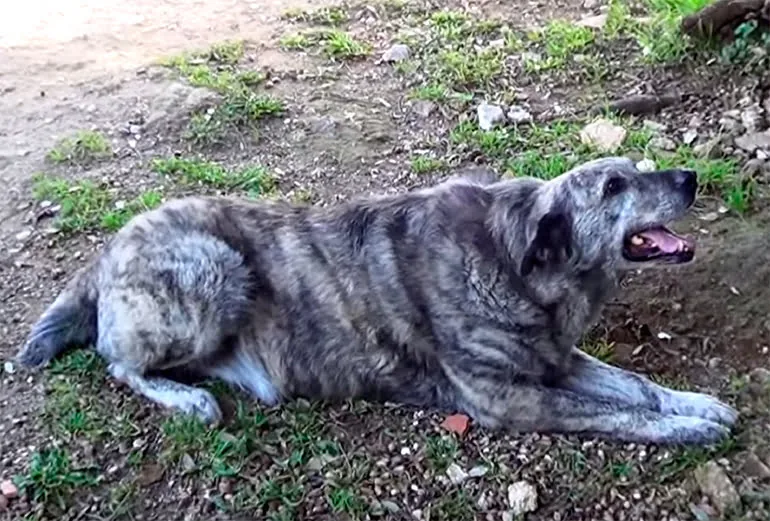
These dogs are large, with a compact build, a wide chest, a powerful neck, and strong legs. Despite their size, they carry themselves athletically and move with great agility. There's no fully fixed standard for the breed, but if there's one trait that defines it, it's the forward-facing position of the eyes. These are small, round, amber-colored, and very lively.
The head is large and square, with a scissor bite and pronounced cheeks. The muzzle is black and shorter than the skull. The ears are medium-sized and usually fold to either side of the head. Although the practice has fallen out of use, Sardinian farmers used to crop them.
The tail is long and is often docked down to a short stump. This is a practice that contributes to giving the dog a more aggressive appearance. 30% of Dogo Sardos are naturally born with short tails. The coat is short, smooth, thick, and coarse. In males, it grows longer around the neck, forming a kind of mane.
 Height between 56 and 68 cm in males and between 54 and 66 cm in females
 Weight between 35 and 45 kg in males and between 30 and 40 kg in females
 Short, smooth coat, coarse to the touch. It has a double layer. The undercoat is woolly and dense, while the outer coat is coarser. The coat is longer around the eyes, muzzle, and chin. Accepted colors are gray, black, brown, white, red, and brindle. Some dogs show black masks
 Docile, dominant, loyal temperament.
 Good health, but prone to hip dysplasia and retinal atrophy
 Estimated life expectancy of between 8 and 10 years
The Dogo Sardo's Temperament
If there's one thing this dog is prized for, it's its courage and complete devotion to whoever it considers its pack. It excels as a guard dog and personal protector. It won't hesitate to defend you with its life if needed. It's not especially well suited to families with children under 10, since it tends to be quite dominant.
The same goes for living with other dogs. Given its strong territorial instinct, it doesn't get along well with other dogs. If you want canine company for a Dogo Sardo, a single dog of the opposite sex works better. That said, if it's been raised from puppyhood with other pets (cats, rabbits, etc.), it will protect them.
It's extremely wary of strangers, and its defensive reaction won't take long to show. Despite its intelligence, it's not easy to train. You'll need more patience and dedication than with other breeds. To train and socialize it, use short sessions and positive reinforcement. In return, it will go out of its way to please you as a 100% loyal pet.
What Care Does the Dogo Sardo Need?
Its upkeep is very simple. You'll need to brush it weekly or every 10 days, trim its nails regularly, clean its ears, and give it intense daily physical activity. A minimum of 1 hour a day, and more if possible. Doing so will help prevent irritability, destructive behavior, and persistent barking.
It'll be the happiest dog in the world if you let it run freely in a green space. A fenced yard or a country house is its ideal home. The Dogo Sardo isn't a suitable dog for city apartment living. If that's your situation, you'll need to significantly increase its daily outings and exercise.
As for diet, being a large breed, you'll need to split the recommended daily amount into several meals throughout the day to keep obesity in check, and make sure it gets the protein, minerals, and carbohydrates its organs need. Omega-3 supplements will help protect its joints.
History of the Breed
There are many theories about how this breed came to be. However, two are the most widely accepted among experts. The first points to its kinship with the Neapolitan Mastiff and the Cane Corso. The second points to Greek, Minoan, and Phoenician traders, who may have introduced it to Sardinia some 7,000 years ago.
A genomic study conducted in 2016 concluded that the Dogo Sardo could be related to Middle Eastern sighthounds, such as the Saluki, and to Hungarian mastiff-type dogs (the Komondor). There are also written records from the 1800s that mention these dogs as allies of Sardinian bandits in their robberies.
These dogs are highly valued by Sardinians, who have historically used them to herd, hunt, and protect their livestock and family from wolves, foxes, and intruders. The Italian army even used them in 1912 during the Libyan campaign. With the introduction of other breeds specialized in hunting wild boar, Dogo Sardos are no longer used for hunting.
Fun Facts About the Dogo Sardo
This breed goes by countless names: Sardinian Molosser, Dogo Sardesco, Pertogatzu, Sorgolinu, and others. It's not recognized by the Fédération Cynologique Internationale (FCI), something that doesn't seem to worry its breeders or the Sardinian population in general. For them, the priority is preserving the breed on the island for its value as a protection dog.
The Dogo Sardo tends to be confused with the Fonni's Shepherd and the Fonni's Mastiff. The first is another long-coated Sardinian breed used for herding, while the second is the result of crossing the Fonni's Shepherd with the Dogo Sardo, or "Pertiatzu cani," as locals call it.
IMPORTANT: This article is for informational purposes only and does not constitute veterinary, nutritional or behavioural advice. Every dog is different, and only your trusted vet can advise you on its specific needs.