 Breeds
Mastiff
The Mastiff is a giant dog breed, considered one of the largest in the world. Its origins can be traced back to the height of the Roman Empire, when a variety of this dog already existed.
Massive and imposing, despite its size it's a calm, gentle dog, though alert and protective in attitude. If you want to know everything about its characteristics, personality, and care, discover the details we've gathered for you. Let's get into it!
Origins of the Mastiff Breed
There are records of the Mastiff's existence dating back to 55 BC. That year, Julius Caesar's troops discovered it during the invasion of Britain. This breed's ancestors are often confused with those of the Tibetan Mastiff, though it's actually an equally ancient but distinct breed.
Back then, the Mastiff was so fierce that the troops decided to bring it to Rome, where these dogs fought in the arenas for public entertainment. From those days to now, the Mastiff's appearance and personality have evolved and changed into the traits we recognize today.
The modern Mastiff has existed since the 15th century. It was used as a hunter, war dog, and guardian. It even took part in the Battle of Agincourt against French troops.
Despite its long history, the breed nearly disappeared during the Second World War, with only 14 Mastiffs left. However, breeders in the United States kept that from happening.
Physical Characteristics of the Mastiff
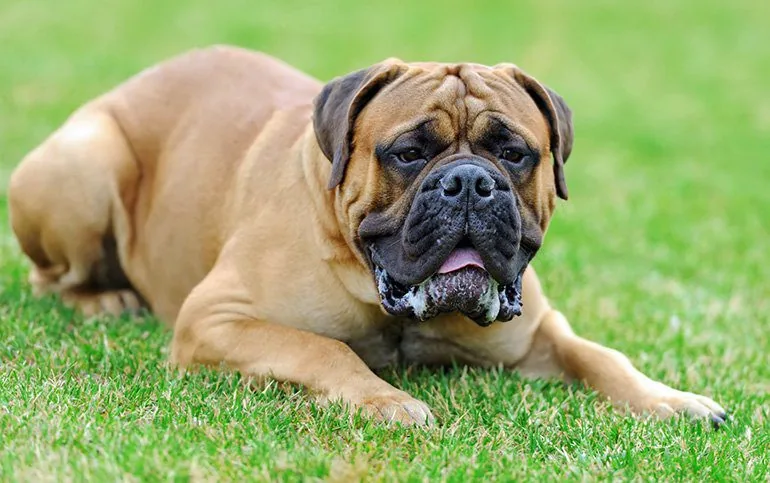
This dog breed stands out for its incredible size and weight, along with an extremely powerful jaw. Under the Fédération Cynologique Internationale (FCI) standard, it's a large dog characterized by a broad, tall appearance with well-spaced legs.
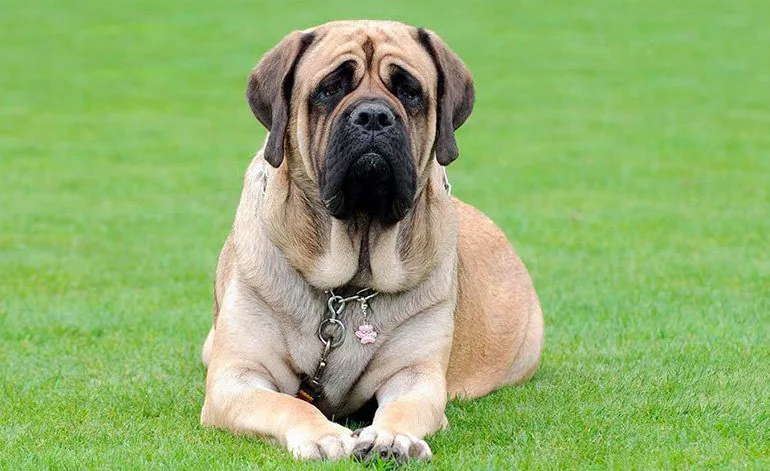
The head is square and wide, with a black nose and a short, square muzzle. The lips hang slightly, and inside them the mouth holds powerful teeth.
The eyes are set apart and have a dark hazel iris. The ears, meanwhile, are thin and hang at the sides of the head.
The Mastiff's coat is short and lies close to the body, with a coarser texture around the neck. The coat comes in fawn or apricot tones, accompanied by a black mask covering the ears, muzzle, nose, and area around the eyes.
 Height of 76 cm in males and 69 cm in females
 Weight between 72 and 105 kg in males and between 54 and 77 kg in females
 Short, fawn-colored coat with a facial mask
 Docile, calm, protective temperament
 Strong health, but with possible hereditary conditions
 Estimated life expectancy of between 8 and 10 years
What Is a Mastiff's Temperament Like?
In the past, the Mastiff was a fierce dog bred for war. Over the centuries, however, its temperament softened. Despite its massive size, today it's an affectionate, noble breed, even a bit of a gentle giant.
It shows confidence and a calm personality, as long as it receives proper socialization; otherwise, it could become a very dominant dog that's hard to control, especially given its size.
Well trained, it'll be an excellent guard dog for you, capable of scaring off anyone who tries to enter your home without permission. On the other hand, if you bring friends home, it will act indifferent toward them — meaning it won't turn aggressive.
If you adopt a dog of this breed, it will regularly seek out your affection and love, which makes it a great companion dog. It also gets along well with children, though you should teach them how to treat the dog to keep them from bothering it.
Care the Mastiff Breed Needs
Although the Mastiff is calm, this isn't a breed for inexperienced owners. The training and socialization process requires confidence; otherwise, the dog will easily intimidate you.
It loves being part of family life, enjoys going for walks, spending time with children, and joining in daily activities. This makes it feel loved and respected. That said, given its size, it's not a good dog for a small apartment; it needs a house with a yard and space to keep itself entertained.
The Mastiff needs regular exercise, but tires very quickly, so calm walks are perfect for it. Walk puppies just one or two blocks; an adult Mastiff, meanwhile, can manage up to 3 kilometers. It tends to lie down when tired, and you won't be able to make it get up, so don't take it too far from home unless you're prepared to carry it back.
Avoid letting it run on stairs or take part in jumping/obstacle exercises; walks and calm games at home are the best options.
The training it needs focuses on socialization and obedience. The Mastiff responds well to sequential training, but avoid being repetitive so it doesn't get bored. Prepare a different routine each day, including varied games and commands, to make the most of the time you spend training it.
Coat Care and Diet
Since it has a short coat, upkeep is simple. One or two brushings a week are enough to remove dead hair. Bathing is recommended once or twice a month.
The Mastiff's face has folds and wrinkles, so it's a good idea to check them frequently to remove any dirt. Likewise, keep up with regular ear cleaning and nail trimming.
Common Diseases in the Mastiff
The Mastiff's massive size comes with a few congenital conditions. Not every dog of the breed will suffer from them, but you should watch for symptoms.
The most common conditions are:
- Elbow / hip dysplasia
- Eye conditions
- Degenerative myelopathy
- Von Willebrand Disease
IMPORTANT: This article is for informational purposes only and does not constitute veterinary, nutritional or behavioural advice. Every dog is different, and only your trusted vet can advise you on its specific needs.