 Training
How Do Dogs Greet People or Other Dogs?
Just as we do, dogs greet each other when they meet us, their own kind, or other animals. If we pay attention to this situation, we'll notice a whole ritual unfolds.
Broadly speaking, dogs will repeat the same gestures. This lets us work out whether the greeting is friendly, in which case we can relax, or whether it's the prelude to a conflict, in which case we can step in early to prevent bigger problems.
The Canine Greeting Ritual
As we well know, dogs are sociable animals, with genetics shaped by pack life, with us humans, and even with other animals they share, to a greater or lesser degree, work or living space with. For example, cats, poultry, rabbits, horses, sheep and so on.
Living their life as part of a more or less extended family unit, it's normal and essential for them to know how to build relationships between every member to keep balance and avoid problems. Greeting helps build and maintain relationships within the family.
Greeting Between Dogs
Generally, dogs always do the same gestures when greeting each other. The greeting is a first contact between the animals, and the final result can be positive, if the dogs accept each other with no issues, or negative, since a conflict can arise between the two. On spotting each other, dogs will approach, taking on a specific posture.
For example, some will tuck their tail between their back legs, while others will hold it up high, wagging it quickly with short, horizontal movements. They may also use vocalisations. So, some will bark in a very high-pitched way, others will growl or bark threateningly, whimper and so on.
The position of the ears, how tense the whole body is, their gaze, whether or not they try to sniff, or the fur standing on end along the withers and spine, are other things we need to pay attention to to know whether the dog is showing a friendly disposition or quite the opposite.
The Canine Greeting Step by Step
Once close, and with each dog's attitude decided, it's common for them to sniff each other's muzzle, ears and, above all, rear end. This gesture strikes people as odd, but it has a simple explanation. There are a pair of glands at the anus that secrete a liquid lubricating faeces and giving the animal their personal scent.
This is what interests the other dog, since it gives information about sex, age, health status, heat and so on. It's also normal for one of the dogs to place their head over the other's withers. If this whole ritual of gestures and sniffing goes well, both dogs start playing or, simply, ignore each other, depending on circumstances.
There are typical postures inviting play, lowering the front legs and head to the ground and raising the hindquarters. It's worth knowing the dog will show this behaviour, or at least try to, when they meet other animals. On another note, the dog will greet any of their own kind on the street, or other dogs they live with, several times a day.
How Dogs Greet People
When it comes to greeting us, the dog changes some details of their ritual. To start, we neither react the same as another dog, nor walk on four legs. This makes them approach us wagging their tail.
Although this has traditionally been read as a sign of joy, the truth is it actually expresses unease. It's the conflict between the desire to approach everything good we represent for them, and the uncertainty around a giant, two-legged animal. What's more, they'll try to approach our face.
This comes from the puppy instinct of asking their mother for food by licking her muzzle and touching her with their paws. That's why some dogs have the habit of getting, or trying to get, up on top of us, going back to that puppy position they once had.
How to Greet a Dog Properly
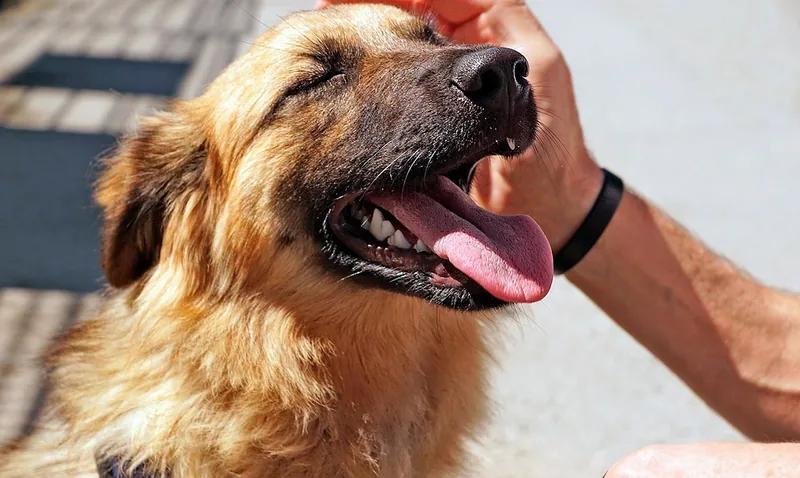
In principle, you should encourage calm behaviour. If your dog comes over and sniffs you, you can stroke them. If, on the other hand, they jump on you or won't stop moving around you, ignore them until they're calm.
Only pay them attention then, and they'll quickly realise that's the behaviour you're after. As for unfamiliar dogs, it's best to ignore them, and only if they approach you calmly and in a friendly way can you gently stroke them in safe areas, such as the top of the head.
My Dog Fights With Another Dog
The best approach when two dogs meet is to let them interact in their own way, unless we see an attack brewing. In fact, often the trigger for an aggressive greeting is the owner's reaction. They tense up thinking there's going to be trouble, and that tension is passed on, without them realising it, to their dog.
The result is the dog gets nervous, and it's easy for them to attack even when the other dog hasn't actually done anything to justify their reaction. The key in this case is training the human to stay calm. This can be practised by seeking out interactions with other dogs belonging to family or friends known to be harmless.
It's possible to meet them somewhere safe where they can interact off the lead. With no human involvement, they'll most likely greet each other normally. Even so, sometimes a dog reacts badly around others because of poor socialisation. In that case, an ethologist or vet specialising in canine behaviour can help us fix it.
Bibliography Morris, Desmond. 1988. Observe a su perro. Barcelona. Plaza & Janés.
IMPORTANT: This article is for informational purposes only and does not constitute veterinary, nutritional or behavioural advice. Every dog is different, and only your trusted vet can advise you on its specific needs.