 Breeds
The Most Nervous Dog Breeds
Some dogs never sit still, get startled by any noise, or live in a constant state of alert. But it's not all nervousness: there's a real difference between high energy and pathological anxiety, and genetics has a lot to say about it. These are the breeds with the greatest predisposition to nervousness, and the keys to understanding why.
What Is a "Nervous" Dog, Really? Telling High Energy Apart From Pathological Anxiety
A nervous dog isn't simply an animal that never sits still. The key is telling apart a high energy level from a state of anxiety that affects the dog's wellbeing. A Border Collie that runs nonstop because it hasn't had mental stimulation isn't nervous — it's a dog with an unmet need.
A dog that trembles, hides, or startles at any noise, on the other hand, shows a pattern of fear-based nervousness, often with a genetic origin.
The difference lies in the cause and the response to the environment. A high-energy dog calms down once it gets the exercise or mental work it needs; its activation is functional and fades once the need is met. A nervous dog, on the other hand, stays in a constant state of alert even in a calm environment.
Its behavior isn't switched off by physical activity — it needs an approach that regulates its emotional system, not just tires it out. A dog living with chronic anxiety struggles to rest, processes everyday stimuli as threats, and can develop repetitive or destructive behaviors.
To find out if your dog is nervous or just energetic, watch how well it relaxes at home. A high-energy dog will lie down and rest once the activity is over. A nervous one stays alert, with rapid breathing, jerky movements, or drooling with no apparent cause. If the state of alert doesn't let up in a predictable, safe environment, we're dealing with something beyond normal liveliness.
The Weight of Heredity: How Genetics Explains Nervousness in Certain Spaniel and Setter Lines
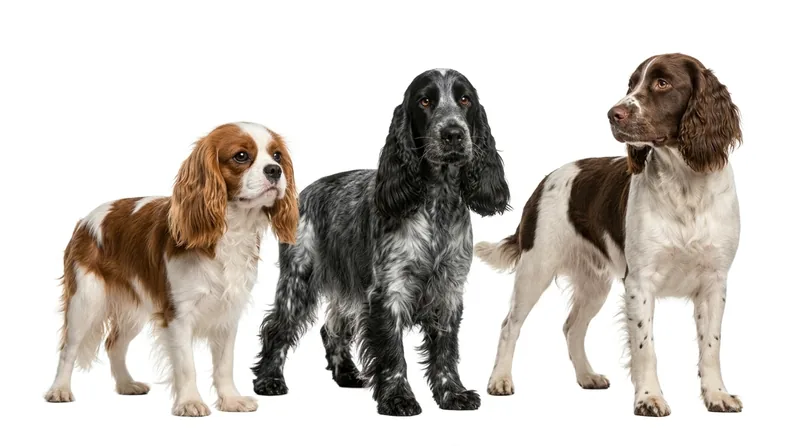
Genetics sets a predisposition toward nervousness that shouldn't be confused with a lack of socialization. In breeds like the Springer Spaniel or the Irish Setter, selective breeding has, for generations, prioritized reactivity and speed in the field. This has fixed a tendency to startle easily into their genes.
In Spaniels, their original job as pointing dogs required constant alertness. That same sensitivity, without the right outlet, turns into restlessness. What was an advantage in the field shows up as nervousness in an apartment without enough outdoor time.
Responsible breeders select individuals with a balanced temperament. When breeding focuses only on looks or competition performance, there's a risk of fixing nervous behaviors into the genetic line. That's why it's worth knowing a dog's background and its parents' history before adopting it.
Not every individual of these breeds is nervous: there are more stable breeding lines, and others where anxiety has been perpetuated by the choice of breeding dogs. Knowing a puppy's background is one of the most useful filters for reducing the risk.
Breeds With Higher Excitability and Fear According to the C-BARQ Questionnaire
The C-BARQ Questionnaire (Canine Behavioral Assessment and Research Questionnaire) is a standardized tool used by owners and vets to assess canine behavior. It measures aspects like excitability, fear of stimuli, and aggressiveness, and its results help identify hereditary patterns across different breeds.
The data collected places the Border Collie, the Shetland Sheepdog, and the Miniature Poodle among the breeds with the highest excitability scores. These dogs tend to react intensely to everyday stimuli, like the doorbell or visitors arriving, with responses ranging from excessive barking to restless movement.
Fear and nervousness aren't the same thing, though they often overlap. Fear is an emotional response to a real or perceived threat; nervousness shows up as generalized hyper-reactivity, with no clear trigger. In breeds like the Shetland Sheepdog, fear of loud noises can combine with innate excitability, producing a dog that startles easily and takes a while to calm down.
The Border Collie shows excitability tied to its high need for stimulation: when it doesn't get the mental and physical work it needs, that energy can show up as reactivity. The Miniature Poodle, on the other hand, often shows social fear, which raises its score on both C-BARQ scales.
Elevated Cortisol and Chronic Nervousness: The Case of Toy Breeds
Cortisol is the hormone that regulates the stress response. When a dog lives in a permanent state of alert, its levels stay chronically elevated. In toy breeds like the Chihuahua or the Yorkshire Terrier, this pattern is especially common, which explains much of their shaky or reactive behavior.
This debunks the myth that "they're nervous because they're small": the origin is physiological and tied to a genetic predisposition toward greater stress reactivity. Selective breeding of companion dogs has, for generations, favored individuals highly sensitive to their environment, which seems to have cemented that hormonal response in certain lines.
It's worth clarifying that cortisol studies in dogs work with varying samples and different contexts, so comparisons between breeds should be taken as trends, not absolute facts. What is documented is that toy dogs frequently show higher baseline stress patterns than breeds bred for physical work requiring less emotional reactivity.
To reduce chronic stress in a toy dog, prioritize predictable routines and safe spaces where it can retreat. Avoid overprotection that reinforces fear, like picking it up at every noise, and focus on early, gradual socialization. If it trembles, hides, or barks uncontrollably as a regular pattern, a vet checkup can rule out health issues and guide specific approaches.
Are There Truly Calm Breeds? What Studies Say About Stable Temperament
Some breeds consistently score low on excitability and fear in behavioral questionnaires. Molosser-type dogs, like the English Bulldog or the Mastiff, tend to show reduced reactivity to everyday stimuli, as do retrievers, whose startle threshold is higher than a Shetland Sheepdog's.
There's a myth that large breeds are naturally calm and small ones are naturally nervous. Size doesn't determine temperament: a well-socialized Dachshund can be more stable than a poorly trained Dogo Argentino. The key lies in each line's genetic selection and the quality of the puppy's early experiences, not its weight or height.
Studies on temperament indicate that the heritability of excitability is moderate, leaving plenty of room to intervene. A dog from a breed considered calm can become reactive if its basic needs for exercise, rest, and predictability aren't met.
IMPORTANT: This article is for informational purposes only and does not constitute veterinary, nutritional or behavioural advice. Every dog is different, and only your trusted vet can advise you on its specific needs.