 Care
Care
Types of Dog Muzzles: Which One to Choose?
Knowing how to properly choose the type of muzzle to use with our dog isn't just recommended — it's mandatory. There are many muzzle models out there, but not all of them work for every dog.
If we choose the wrong model for our dog, we won't just be putting other dogs or people's safety at risk — we'll also be putting its own health in danger. Some muzzles don't even let the dog pant.
At SoyUnPerro, we're going to explain the most commonly used types of dog muzzles, and which are best suited for different breeds and dog sizes.
Dog Muzzles: The Fabric or Nylon Muzzle
Although this type of muzzle is visually appealing, the truth is they're not the most recommended for our beloved furry friends. Looking closely, you'll notice they barely give the dog room to stick out its tongue and pant, which is essential for cooling down, since, as we all know, dogs don't sweat — they regulate their body temperature through panting.
Also, being unable to open its mouth even slightly to stick out its tongue also prevents it from drinking water. As if that weren't enough, continuous friction on the snout will end up causing irritation — let's not forget the snout is one of a dog's most sensitive areas.
In our view, and although we admit they're very pretty muzzles, we don't recommend, and never will recommend, using fabric or nylon muzzles. This is due to how impractical they are and the harm they can cause to a dog's health.
Dog Muzzles: The Classic Basket Muzzle
You're surely well familiar with this type of dog muzzle, since it's the oldest and most widely used. And it remains the most commonly used model precisely because it's useful and very practical, unlike newer fabric models.
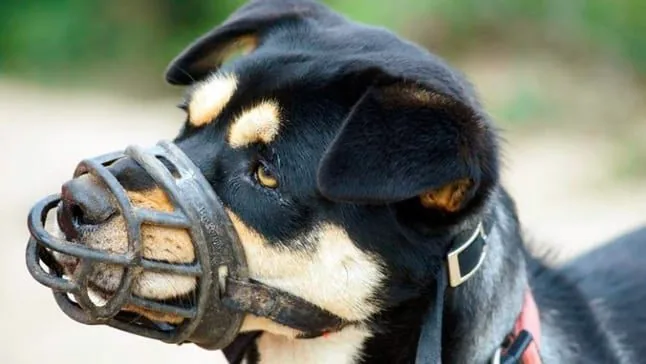
The basket muzzle, also known as the cage muzzle, is characterized by fully covering the dog's snout while letting it open its mouth inside it and stick out its tongue to pant or drink water.

This is, without a doubt, the most recommended muzzle among all existing models, always making sure to get the right size for our dog. There are muzzles for large dog breeds and muzzles for medium or small dogs — don't make the mistake of choosing the wrong size.
Muzzle for Brachycephalic Dogs
Among basket-type muzzles for dogs, we can find a special line for brachycephalic dogs. These are dogs that, genetically, have a smaller/flatter snout than usual.
Obviously, having a shorter snout means a conventional basket muzzle would be too big and could easily be removed, even if the size otherwise fits. That's why muzzles for brachycephalic dogs were invented — basket muzzles with a shorter snout section.
The dog breeds that should use this specific type of muzzle include:
- Boxer
- French Bulldog
- Boston Terrier
- Pug
- Shih Tzu, etc...
Dog Muzzles: The Anti-Pull Muzzle
Another new addition among dog muzzles is the so-called loop or anti-pull muzzle, which attaches to the leash and tightens, forcing the dog to tilt its head down when it pulls.
This type of muzzle does let the dog stick out its tongue to pant or drink water, but it's highly dangerous, since tightening while catching the dog off guard will cause it to bite its own tongue more than once.

This type of dog muzzle is used too often to stop a dog from pulling, but it's not recommended for this, since although the dog may stop pulling on the leash during the walk, or do so less often, we're not actually teaching it not to pull — we're punishing it in a way.
There are special harnesses that keep dogs with more character and energy from pulling as strongly, so we don't recommend this type of muzzle.
Which Dogs Need to Wear a Muzzle, and When Is It Necessary?
Every country has its own laws regarding muzzle use in dogs. In Spain and Mexico, every dog breed classified as potentially dangerous (PPP) must wear an approved muzzle at all times whenever in public spaces.
Dogs not classified as PPP but that have at some point been reported for biting or attacking must also always wear a muzzle in public spaces. Dog parks aren't private spaces, so these types of dogs must also wear a muzzle inside them.
There's a type of muzzle designed specifically for Pit Bulls, based on their snout and head measurements. Since the Pit Bull is a very popular breed and is required to wear a muzzle, manufacturers wasted no time developing a custom-fit one. The basket muzzle is always the most recommended.

Remember dogs wearing a muzzle have a harder time opening their mouth fully, which prevents them from panting normally. This means you should never exercise a dog while it's wearing a muzzle, except for basket-type muzzles that let it pant normally.
How to Put a Muzzle on a Dog?
Dogs don't like wearing a muzzle, which is completely understandable, since it limits their functions and is uncomfortable for them. That's why it's very important to know how to put a muzzle on a dog, so it gets used to it and can walk calmly while wearing one.
The best approach is starting to put the muzzle on our dog from puppyhood, even inside the house. We'll do this in short periods of time, first a few minutes, and as the weeks pass with daily practice, longer.
It's completely normal for them to try to take it off, so we should distract them with games or anything that diverts their attention. This way, they'll gradually get used to wearing the muzzle, and when it's truly necessary to put it on, there won't be any problems.
Muzzles for small dogs are almost tiny in size, so make sure it's not excessively tight and lets it open its mouth a little to stick out its tongue. If the dog is still growing, which happens from birth until around a year and a half old, remember to change the muzzle size as needed.
IMPORTANT: This article is for informational purposes only and does not constitute veterinary, nutritional or behavioural advice. Every dog is different, and only your trusted vet can advise you on its specific needs.