 Breeds
White Swiss Shepherd: Temperament, Care and Fun Facts
The FCI didn't recognise him as a breed in his own right until 2011, but the White Swiss Shepherd has been more than just a light-coated German Shepherd for decades. A straight back, a serene temperament, and a bearing that rivals any other herding breed.
How he differs from the German Shepherd and other white breeds
That said, hip dysplasia shows up at a high rate in this breed, and anyone wanting one should demand screening tests before taking the step.
The White Swiss Shepherd, or Berger Blanc Suisse, shares an ancestral trunk with the German Shepherd. A common history, yes, but the two have gone their separate ways for decades. The breaking point came in the 1930s, when the German breed club declared a white coat an eliminating fault. Up until then that colour appeared quite normally in the early German herding lines, but from that point on white individuals almost vanished from Europe. Breeders who still valued their working ability exported them, mainly to Switzerland and the United States. In North America they continued to be registered as a German Shepherd variety for decades; in Switzerland, however, an independent breeding programme was launched that ended with official recognition by the Fédération Cynologique Internationale (FCI) in 2011, now under his own name: White Swiss Shepherd.
The white coat is the first thing that catches the eye, of course. But that's not where the differences end. The White Swiss Shepherd's silhouette is more moderate than that of many German Shepherd show lines: the topline stays straight and level, without that steeply sloping angulation sought in the German show ring. That has practical consequences, since movement ends up more balanced and the predisposition to certain joint problems drops. As for temperament, selection has gone in a different direction, prioritising emotional stability and the ability to live with people, setting aside the high prey or defence drive that defines the working German Shepherd. The protective instinct is still there, but the response is calmer, more watch-before-acting.
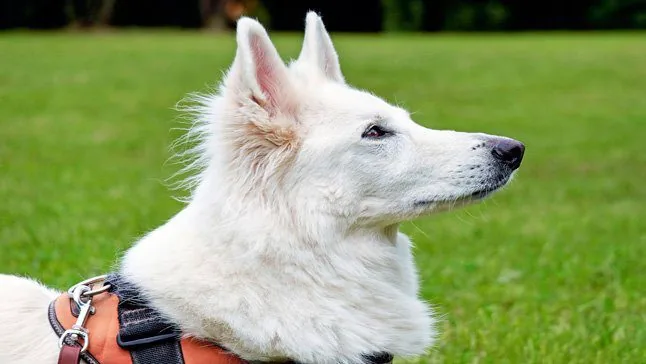
Many people confuse them with white-coated spitz breeds like the Samoyed or the American Eskimo Dog. Watch out for this, because the White Swiss Shepherd is a wolf-type herding dog, and it shows in every detail of his head: an elongated wedge, moderate stop, erect triangular ears, an attentive, serious expression. Nothing like the rounder head and almond-shaped eyes so characteristic of spitz breeds. He shouldn't be mixed up with the Beauceron or the Briard either, French herding breeds that can carry light coats but with a very different bone structure and coat. And although the Shetland Sheepdog belongs to the same cynological group, his build and origin have little in common. The White Swiss Shepherd standard leaves no room for interpretation: white only, no exceptions. Any other coat pigmentation is an automatic disqualification in the show ring.
Genetics and preventive health in the White Swiss Shepherd
Any breeder who takes this breed seriously needs to know the panel of available genetic tests. Cerebellar cortical hypoplasia is one of the most documented and also one of the most serious. It disrupts cerebellar development, and its first symptoms — ataxia, tremors and lack of coordination — appear within the first weeks of life. Its cause is well pinned down, a frameshift deletion mutation in the Reelin gene, identified in the scientific literature on the breed ‘A frameshift-deletion mutation in Reelin causes cerebellar hypoplasia in White Swiss…’ (2023). Knowing whether an animal is clear, a carrier or affected is possible with the specific test, and that information completely changes how matings are planned.
Pituitary dwarfism is another genetically based endocrine disorder worth not underestimating. It goes beyond simple growth delay and includes coat changes and, in some cases, subsequent pituitary hypocortisolism. A nine-week-old White Swiss Shepherd puppy with growth delay was diagnosed with this condition due to a mutation in the LHX3 gene and later developed exactly that pituitary hypocortisolism ‘Pituitary Dwarfism and Adrenocorticotropic Hormone Deficiency in a White Swiss…’ (2025). Catching it early improves clinical management and, above all, allows carrier individuals to be excluded from breeding. Along with the cerebellar hypoplasia test, this should be part of the minimum screening required before breeding.
Genetic tests cover part of the protocol, but not all of it. Hip and elbow dysplasia have a polygenic hereditary component with significant environmental influence, meaning no DNA test resolves it on its own. Evaluation requires official X-rays and certification by specialists following FCI-recognised scoring systems, and it needs to happen before the animal enters breeding. Regular eye exams and a basic cardiac check-up round out the preventive picture. A good plan also includes vaccination adapted to the dog's lifestyle, regular deworming and six-monthly vet check-ups to catch any problem before it settles in.
Origin and history
The White Swiss Shepherd has his roots in the earliest German herding dogs of the late 19th century, among which white was a fairly common occurrence. In fact, Horand von Grafrath himself, considered the first registered German Shepherd, was the grandson of a white dog. However, once the breed club in Germany decided white was a fault to be eliminated, many individuals were excluded from breeding. Breeders in other countries, especially the United States and Canada, kept selecting these white dogs for their working ability and balanced temperament, maintaining lines registered as white German Shepherds.
The turning point toward an independent breed happened in Switzerland. From the 1970s onward, with the import of white individuals from North America and some European countries, a systematic breeding programme began with the goal of fixing a uniform type and gaining official recognition. The breed's first association was founded in Switzerland, and the chosen name was Berger Blanc Suisse (White Swiss Shepherd). After decades of selective work, the FCI provisionally recognised the breed in 2002 and permanently in 2011, placing him in Group 1, Section 1: Sheepdogs — a group he shares with Iberian breeds such as the Catalan Sheepdog. This recognition cemented the definitive separation from the German Shepherd and established his own standard describing a versatile herding dog, white-coated and even-tempered.
The breed's history shows how a trait considered undesirable in one context can become the emblem of a new breed when viewed from a different functional and aesthetic perspective. The White Swiss Shepherd isn't a white German Shepherd, but the result of divergent selection that has prioritised joint health, temperament stability and suitability for family life, without giving up the intelligence and learning ability that define central European herding dogs.
Physical characteristics
A large, muscular dog with slightly elongated proportions. That's the first thing that catches the eye: an animal conveying solidity without appearing heavy, with a substantial bone structure that never tips into coarseness. The topline stays straight and firm, and the croup — long, with a gentle slope — lets the trot, the movement that defines the breed, flow smoothly, transmitting the rear drive well through each stride.
White is the only coat colour the standard accepts, no exceptions or nuances. There are two coat varieties: medium-length, with a dense double coat lying close to the body and a thick undercoat protecting against cold and rain; and long, forming feathering on the ears, legs and tail. The nose, lips, eyelids and pads should be black-pigmented, and there's a reason for that. The coat's white comes from a gene that masks the base coat colour. He isn't albino. A wedge-shaped head, moderate stop, deep dark brown almond-shaped eyes and high-set triangular ears, always erect. The sabre-shaped tail reaches at least to the hock, hangs low at rest and rises during movement without going above the topline.
A dog who conveys intelligence and liveliness through his gaze. No tension, no nerves. Unlike certain German Shepherd show lines, there's no exaggerated rear angulation here, and it shows in more natural movement and joints working under less mechanical stress. Males and females are easy to tell apart: males are more powerful and sturdy, females have a finer, more feminine build. But in both cases the dog should give an impression of solidity and stamina, of an animal able to cover long distances at a trot without showing fatigue.
Temperament and life together
Few herding breeds combine as much energy with the emotional stability that defines the White Swiss Shepherd. He's affectionate, sociable and fairly balanced, without the reactivity spikes seen in breeds more oriented toward guarding, like the Mallorcan Shepherd. With his family he builds a very close bond, and with people in general he shows curiosity and openness, provided he's had good socialisation from puppyhood. With children he behaves well: patient, tolerant, though his size and enthusiasm for play call for supervision, since an accidental stumble could end badly. An individual who's excessively shy or prone to aggression falls outside the breed standard. Watch out for this when choosing a breeder.
His versatility as a working dog is real. Like the Australian Shepherd, he's proven he can fit into very different disciplines: agility, competitive obedience, tracking, herding — any activity that demands both thinking and moving at once. Where he shines most, however, is in therapy and assistance work. He has an unusually stable temperament, letting him interact with vulnerable people without falling apart under stress. He also performs well in search and rescue, provided training is positive and respects his pace. Guarding and sport protection work, on the other hand, aren't his thing. His selection has favoured composure over combativeness.
Living with him requires real commitment. A White Swiss Shepherd with no stimulation gets bored, and once he's bored, barking, chewed furniture and general chaos follow. It isn't innate destructiveness: it's a lack of occupation, which is something quite different. Scent games, Kongs, interactive puzzles and short training sessions suit him perfectly. Living in a flat is perfectly viable, but he needs taking out two or three times a day with real intent: aerobic exercise, time to explore, no cut-short walks.
Care and grooming
Keeping that white coat in good shape takes consistency, though there's no need to overdramatise it either. The double coat filters out a fair amount of everyday dirt, but the light colour doesn't forgive: any stain stands out a mile off. Two or three thorough weekly brushings are enough in normal times — first a long-pin comb to work through tangles, then an undercoat rake to lift out dead hair. Watch for seasonal shedding: when it hits, switch to daily brushing unless you want the house covered in white fur. Bathing is best saved for when the dog comes home a mess, or before a show; wash too often and you end up stripping the skin's natural oils, leaving the coat without that shine.
The ears need a weekly clean with a specific solution, especially in longer-coated individuals where the ear canal breathes worse and ear infections show up more easily. Nails, every three or four weeks as a rule, though if you hear them clicking on the floor it's already time — nails that are too long gradually change the gait and load the joints. The mouth is the area most people neglect. Brushing with enzymatic dog toothpaste three times a week — daily if possible — prevents periodontal disease, which causes chronic inflammation with consequences reaching well beyond the mouth.
Without exercise, a White Swiss Shepherd goes off the rails. An adult needs 60 to 90 minutes of activity a day, split across several outings. A lead walk does the bare minimum; what genuinely benefits him is free-play time in safe spaces, obedience sessions that make him think, and, when possible, a sport discipline like canicross or agility. From puppyhood, exposing him to different surfaces and terrain aids proprioceptive development and builds joint solidity. In summer, watch the less-pigmented areas — nose, eyelid rims — since they burn easily; for extended sun exposure, there are sunscreens formulated specifically for dogs.
Health and common conditions
As a fairly large breed, he has his weak points. The most common is hip dysplasia, that malformation of the hip joint that can range from mild discomfort to lameness that severely limits the animal's quality of life. Genetics, diet and how exercise is managed during growth carry as much weight as family heredity in understanding why it develops. Elbow dysplasia shows up less often, but it's also documented in the breed and should be assessed with the same official certification protocol.
Degenerative myelopathy deserves separate attention. This neurological disorder shares a genetic basis with the one seen in the German Shepherd, progressively deteriorates the spinal cord, and usually becomes noticeable in older dogs, when the hindquarters start failing with weakness and loss of coordination. Idiopathic epilepsy and allergies, whether skin or food-related, also show up occasionally, though not at a rate high enough to consider them endemic breed problems. Watch out for areas of white or less-pigmented skin, which are more sensitive to sun radiation; it's best to avoid direct exposure during the middle of the day and apply protection to the more vulnerable areas.
Controlling weight throughout the dog's life reduces mechanical load on the joints and lowers the risk of subclinical dysplasia turning into a real problem. Nothing complicated, but it does need to be consistent. In puppies, feeding needs to be measured so they don't gain weight too fast, and exercise needs adjusting to each stage of development to avoid overloading cartilage that's still forming. Regular vet check-ups, including orthopaedic palpation and X-rays if the vet considers it appropriate once the dog reaches maturity, catch abnormalities before they cause problems. If he limps, changes behaviour or shows any neurological sign, see the vet without delay.
Recommended diet
A high-end kibble designed for medium or large breeds, with animal protein as the base, is the most sensible starting point for feeding a White Swiss Shepherd. The exact amount depends on the manufacturer, but what matters most in the end is the dog in front of you: the ribs should be palpable under a light layer of fat, and the waist should be visible from above. A couple of extra kilos weigh heavily on the joints of a dog this size.
During puppyhood, care is needed. Kibble formulated for large-breed puppies regulates calcium and phosphorus levels so bones grow at a steady pace, with an energy density that doesn't accelerate growth rate. Up to six months, three or four meals a day; from there, two. That split also reduces the risk of gastric torsion, a complication deep-chested dogs like the White Swiss Shepherd have some predisposition to. It helps to avoid intense exercise in the hour before and after each meal, and if the dog gulps food like there's no tomorrow, an anti-gulping bowl does its job.
Some individuals develop sensitivities showing up in the skin or digestive system. When this happens, always with the vet involved, an elimination diet with hydrolysed protein or a protein source the dog hasn't tried before is used to pin down the offending ingredient. Fish oil, rich in omega-3, has a good reputation for skin health and modulating joint inflammation, but adding it should respond to a specific need, not just what's trending. And the most basic thing of all: fresh water available at all times.
This dog's wellbeing depends on genetics, handling and preventive vet follow-up all working together. Anyone wanting one would do well to look for breeders who provide health tests in order and to plan, from day one, a routine covering what this dog needs, both physically and mentally.
Anyone living with a White Swiss Shepherd quickly learns his mind needs work. Recreational herding, scent games, any activity that forces him to think: all of that prevents behavioural problems and sharpens the bond in a way walks alone can't achieve.
IMPORTANT: This article is for informational purposes only and does not constitute veterinary, nutritional or behavioural advice. Every dog is different, and only your trusted vet can advise you on its specific needs.