 Care
Care
How and Where Do Dogs Sweat?
Dogs don't sweat the same way we humans do. Unlike us, they don't have numerous sweat glands all over their body — instead, these are concentrated only in their paw pads.
Because of this, their main cooling mechanism is panting, which lets them exchange hot air for cold air to cool off. Let's look in detail at how dogs sweat and their most notable quirks.
Dogs Sweat Through Their Paws
Dogs have sweat glands, but only located in the pads of their four paws. These glands fall under the category of skin appendages and are located in the dermis, the layer beneath the epidermis, or outermost layer of skin.
It's believed sweat glands were reduced to this minimal presence because they were ineffective under the thick coat of dogs' ancestors. This coat was designed more to retain heat than to cool down. Today, with breeds having thin or almost no fur, sweating could be useful as a thermoregulation mechanism for these dogs.
That evolution hasn't happened. Sweat glands remain limited to the pads in today's breeds, including so-called hairless dogs like the Chinese Crested. The small number of sweat glands dogs have is insufficient to cool them down. That's why they've had to rely on another mechanism: panting.
Why Does My Dog Pant?
Dogs don't sweat through their skin like humans. This lack of sweating makes them more sensitive than us to high ambient temperatures. Their thermoregulation is less efficient. The mechanism they've developed to lower their body temperature is mainly panting. Panting lets them exchange hot air for cooler air.
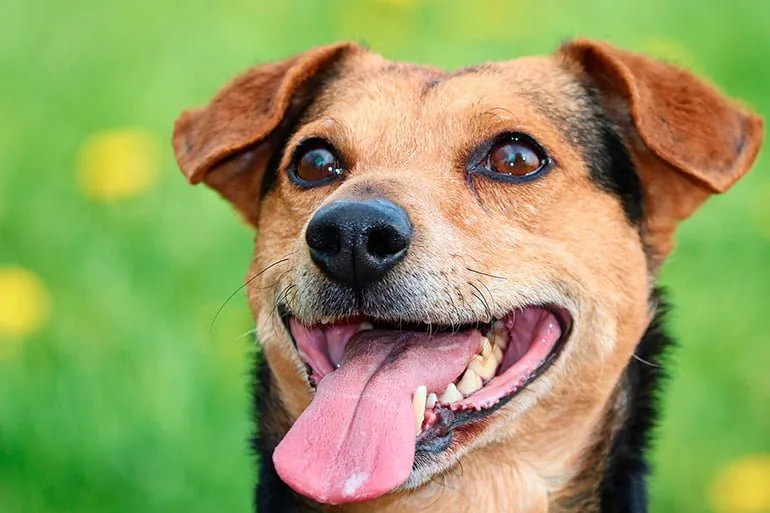
Hot air from inside the body rises to the mouth, where it condenses on contact with the tongue and mucous membranes, which are at a lower temperature, and evaporates, exchanging with atmospheric air at a lower temperature. As soon as it feels hot, the dog opens its mouth wide, sticks out its tongue, pants, and breathes faster.
During this process, it may drink water to keep the tongue's surface wet. It's also common to notice drops falling from the tongue to the floor, a result of condensation. If the air temperature is very similar to the dog's body temperature, between 38-39°C (100.4-102.2°F), panting won't be effective enough.
Heatstroke in Dogs
When a dog's body generates more heat than it can release, or the ambient temperature where it is is too high, heatstroke can occur. This is a veterinary emergency that puts the dog's life at risk.
Heavy panting, breathing difficulties, congested mucous membranes, vomiting, or bloody diarrhea are symptoms that can appear in these cases. If the dog's body temperature isn't lowered, collapse and death will follow.
Normal vs. Abnormal Panting in Dogs
Outside of heat-related panting, if a dog breathes with more or less difficulty through its mouth rather than its nose, which is normal, it could be experiencing breathing problems that need to be assessed by a vet.
So, it's important to tell apart panting from rapid breathing to know when to step in. Of course, if panting is excessive and other symptoms consistent with heatstroke appear, you need to contact your vet immediately.
The Ideal Temperature for Dogs
Given the difficulties a dog can experience regulating its body temperature, it's a good idea to provide a safe environment. Meaning, we need to avoid exposing it to or keeping it in high temperatures.
Brachycephalic dogs are at greater risk, since they have a small, flattened nose that predisposes them to breathing problems. Also, individuals with heart or lung issues may have their breathing ability affected.
They'll be at greater risk if forced to pant. On top of that, these risks are more common in dogs already running a fever for any reason. The recommended measures to keep in mind are:
- Keep the dog in a cool place during the hottest, most humid hours. Preferably indoors.
- Of course, never leave it inside a closed vehicle.
- When traveling, if using a carrier, make sure it allows good, constant ventilation.
- Don't let it do intense exercise during the hottest hours of the day.
- If it stays outside, make sure it always has shade.
- Clean, fresh water needs to be available on demand throughout the day.
- Avoid leaving it on concrete or asphalt surfaces, which reach high temperatures when exposed to the sun.
- Always keep an eye on it if it's wearing a muzzle, since this makes panting harder.
Bibliography Carlson and Giffin. 2002. Dog Owner's Home Veterinary Handbook. Madrid: Editorial el Drac. Morris, Desmond. 1986. Dog Watching. Barcelona: Plaza & Janés.
IMPORTANT: This article is for informational purposes only and does not constitute veterinary, nutritional or behavioural advice. Every dog is different, and only your trusted vet can advise you on its specific needs.