 Care
Care
How to Clean a Dog's Teeth? We Show You How!
The truth is few caregivers pay regular attention to their dog's teeth. A lack of oral hygiene can lead to serious health problems, and not just in the gums or teeth.
Besides regular vet checkups and care, at home we can follow a series of measures aimed at keeping its teeth in the best possible condition. It's important to start this hygiene from puppyhood. Let's see how to go about it.
Dental Hygiene for Dogs
You'll find different oral cleaning products for sale. What they have in common is that they've all been specifically formulated for dogs. We should never use a brush or toothpaste made for people. That's designed to produce foam, which can be unpleasant for the dog. Also, it doesn't know how to rinse or spit.
The vet or the dog groomer will be the ones to recommend the best products for our dog. Getting advice matters, since toothpaste formulas vary. Some contain abrasives, oxygenating agents that limit bacterial growth, disinfectant chlorhexidine, or zinc that promotes healing of gum conditions.
That's why we should consider the dog's condition to choose the most suitable one, especially if it already has some oral problem. If it's a healthy dog, we could make our own paste by mixing a tablespoon of baking soda with a teaspoon of water.
Tooth Brushing Technique
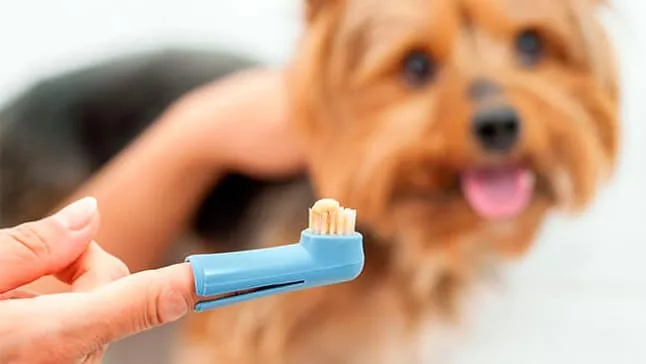
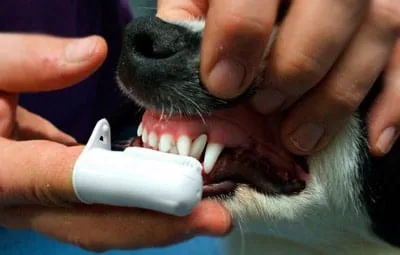
We can clean teeth and gums with our finger or with a soft nylon brush. If we go with the finger, we'll need to wrap it in gauze. We'll put the toothpaste on it. Carefully, and looking for a moment when the dog is calm, especially if it's the first time, we'll lift the lip and rub the teeth and gums.
The motion should be done gently, making circular movements. If we're too forceful we could cause bleeding. In principle, we don't need to clean the inner surface of the teeth, since the dog, with its tongue, will spread the paste to every area.
If, on the other hand, we choose to use a special brush, we'll need to position it at an angle of roughly 45 degrees, parallel to the gums. We'll move it in small circles over both the teeth and the gums. Special attention should be paid to the area where the tooth meets the gum.
Getting the Dog Used to the Toothbrush
Oral hygiene steps aren't complex, but it's common for the dog not to accept them at first. Whether we start applying them to puppies or adults, we should plan it as a gradual process. At first, we can be satisfied if we manage to brush one side or for a few seconds.
If the dog struggles or gets too uncomfortable, we should never force it. It's better to end the session with a reward. This way it will be receptive to the next cleaning. As it gets used to it, encouraged by our praise and rewards, never by punishment or shouting, we'll gradually increase the time and area brushed.
Maintaining Oral Hygiene
Besides tooth brushing, we can keep in mind a series of measures that will help maintain healthy teeth. In fact, these guidelines can almost completely prevent dental illnesses. They are the following:
- Although it has other drawbacks, dry kibble is generally considered to help keep teeth clean.
- It's also been shown that dogs fed a BARF diet suffer fewer oral problems, since the diet itself helps clean their teeth (by chewing on bones, for example).
- It's better to give the dog its food in one or several servings a day rather than allowing continuous access to food.
- If the dog's menu consists of wet or homemade food, it's a good idea to also offer dry biscuits or similar to help clean the teeth.
- Tooth brushing should be included in the hygiene routine several times a week, using toothpaste specifically made for dogs.
- Hygiene measures should start as early as possible, since they'll be much more effective if we start while the mouth is still healthy.
- In dogs that already have some oral problem, tooth brushing should be daily.
- Don't offer the dog overly hard objects to chew on.
- Take it for an annual dental checkup. If it has tartar, it can be removed during this visit. This is done with an ultrasound cleaning under general anesthesia. You can also use natural techniques to remove tartar.

Warning Signs
If we haven't brushed our dog's teeth or we adopted it with oral problems already, there's a series of symptoms that will tell us we need to see the vet. These cases can't be solved just by brushing the teeth. These are the warning signs:
- Eating slowly or stopping eating.
- Larger or heavier pieces of food fall out of the dog's mouth.
- Tilting its head.
- Excessive drooling.
- Bad breath.
- Nausea.
- Trouble swallowing.
- Trouble opening and closing its mouth.
- Gingivitis
Bibliography Carlson and Giffin. 2002. Practical Manual of Canine Veterinary Medicine. Madrid. Editorial el Drac.
IMPORTANT: This article is for informational purposes only and does not constitute veterinary, nutritional or behavioural advice. Every dog is different, and only your trusted vet can advise you on its specific needs.