 Care
Care
Why Does My Dog Have Stains Under Its Eyes?
If we notice our dog has a stain under its eye that never quite goes away, it's natural to worry. In this SoyUnPerro article, we'll explain why this staining happens and how to fix it.
What Is Epiphora?
Epiphora, tearing, or watery eye can be defined as the overflow of watery or mucous eye discharge, which spills out of the eye and runs down the face, forming a trail from the inner corner of the eye.
There are different conditions that can cause this, and all of them require veterinary treatment.
Some diseases that come with heavy discharge include conjunctivitis, entropion, corneal ulcers, uveitis, glaucoma, etc. A foreign body inside the eye can also cause tearing. Even fur from the face rubbing against the eye can produce the same effect.
Distichiasis, a congenital condition in which a double row of eyelashes grows in, is another cause of epiphora. These eyelashes grow pointing toward the inside of the eye, and it's this irritation that causes the tearing. It's more common in breeds like the Cocker Spaniel, Poodle, or Pekingese. These eyelashes need to be removed.
Even though it might seem like just a cosmetic issue, the truth is it can be very uncomfortable for the dog, and if the underlying problems go untreated, the condition can become much more complicated.
In addition, in cases where the discharge is very heavy, skin problems can develop. Constant moisture damages the skin, causing it to become inflamed and/or infected, worsening the problem and making it harder to heal.
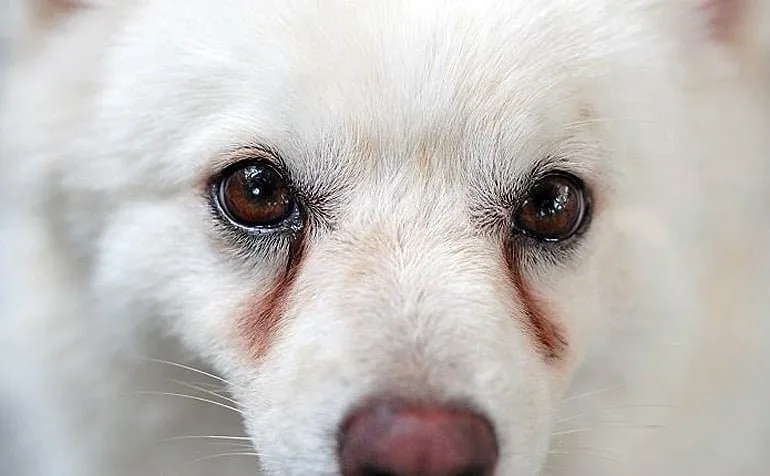
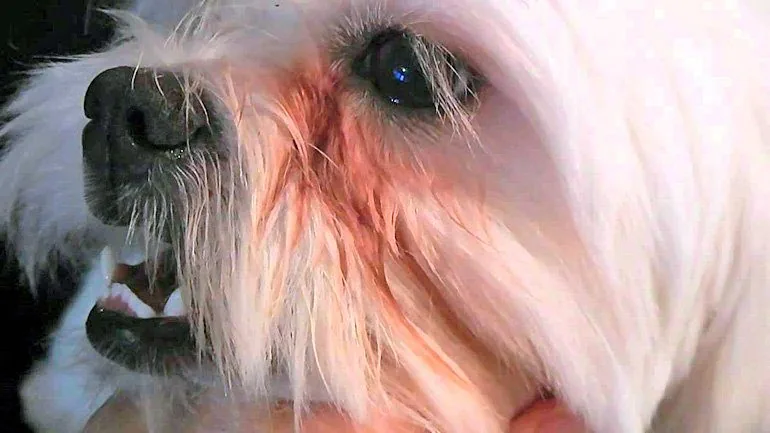
This heavy discharge running from the corner of the eye ends up causing a reddish-brown discoloration of the fur in that area. This makes it look like the dog always has a stain around its eyes. This is especially noticeable in white dogs.
Obstruction in the Canine Tear Drainage System
We've covered causes of epiphora based on eye irritation, but sometimes excess tearing is due to an obstruction in the tear drainage system. Some dogs are born with this defect, especially the Cocker Spaniel breed.
This tear drainage mechanism consists of a nasolacrimal duct, responsible for collecting tears from the eye and carrying them to the nasal cavity, where they're emptied. The duct splits into two canaliculi at the corner of the eye, upper and lower, located in the upper and lower eyelids respectively.
Problems like entropion, purulent conjunctivitis, infection in the duct, or the presence of foreign bodies can end up blocking this drainage system, causing tears to overflow.
To check whether the nasolacrimal duct is blocked, the vet may instill fluorescein into the eye. If this dye doesn't come out through the nose, we can say there's an obstruction.
Sometimes simply flushing the duct is enough to clear the blockage and keep it open. Treatment will also depend on the underlying condition. Antibiotics and anti-inflammatories may be needed. In some cases, surgery will be required.
Why Do Tears Stain My Dog's Eyes?
Excess tears overflowing the eye and running down leave a reddish trail on the dog's face. Tears, although they look clear to us, contain a number of chemical substances that, when reacting with light, produce that discoloration that looks like a stain.
So, if our dog has epiphora and is white or light-colored, this staining will be very noticeable. It isn't a cause for alarm in itself — it isn't blood, it's just cosmetic — but it does require a vet visit, since we need to find out why the tears are overflowing.
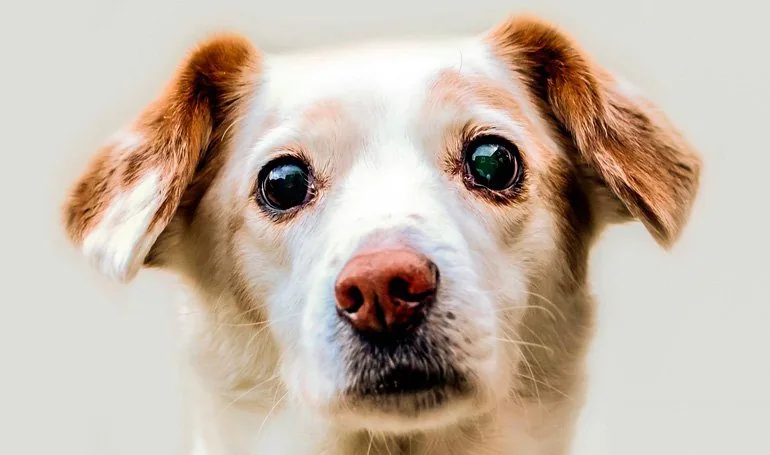
There are breeds where epiphora is more common, such as the Poodle, Lhasa Apso, Maltese, Pomeranian, or Pekingese. It's not entirely clear why these dogs are more prone to this problem.
How to Get Rid of the Stains Under the Eye
The most important thing is to diagnose the cause of the excessive tearing and follow the treatment the vet prescribes. This way, if the dog stops tearing excessively, these stains won't form either. The problem is that we won't always get a diagnosis, so the epiphora may become chronic.
There are some drugs that react with the substances in tears responsible for the reddish tone, so that, even if discharge continues to be heavy, the fur won't discolor. Of course, once treatment is stopped, the reddish staining will return to the fur.
For more complex cases where there seems to be no solution, surgery could be considered. This would involve removing part of the tear gland in the third eyelid. This reduces tear production and increases the space where tears can pool. This way, the excess is controlled.
The problem with this type of surgery is that it could have the opposite effect — drying out the eye and causing a condition known as dry eye (keratoconjunctivitis sicca). So, before going ahead with surgery, it's important to consult a vet specialized in ophthalmology.
Cosmetically, we can improve this staining by trimming the fur in the area as much as possible. There are also different products available with a cleaning or dyeing effect. Before using them, it's best to consult with the vet or a dog groomer.
Whichever product we choose, it's essential to apply it with caution so that it never comes into contact with the eye, since it could cause serious irritation.
IMPORTANT: This article is for informational purposes only and does not constitute veterinary, nutritional or behavioural advice. Every dog is different, and only your trusted vet can advise you on its specific needs.