 Care
Care
Can a Dog Have a C-Section?
A C-section is an increasingly common abdominal surgery in human medicine. In theory, it's prescribed when a natural birth isn't possible for various reasons. But is this operation performed in veterinary medicine too? Can a pregnant dog give birth by C-section?
What Does a C-Section Involve?
A C-section is an operation in which, through an incision in the abdomen, the uterus is accessed in order to remove the fetus or fetuses inside that can't be born naturally.
Of course, this is a procedure that requires general anesthesia and all the monitoring of a surgical suite, to keep the mother's vital signs stable and protect the newborns' lives. Like any surgery, a C-section also involves recovery time and basic post-operative care, as well as risks.

C-Sections for Dogs in Veterinary Medicine
Indeed, situations can also arise in female dogs that call for a C-section. These may occur during labor, or the vet may detect them beforehand. Either way, the procedure will be the same.
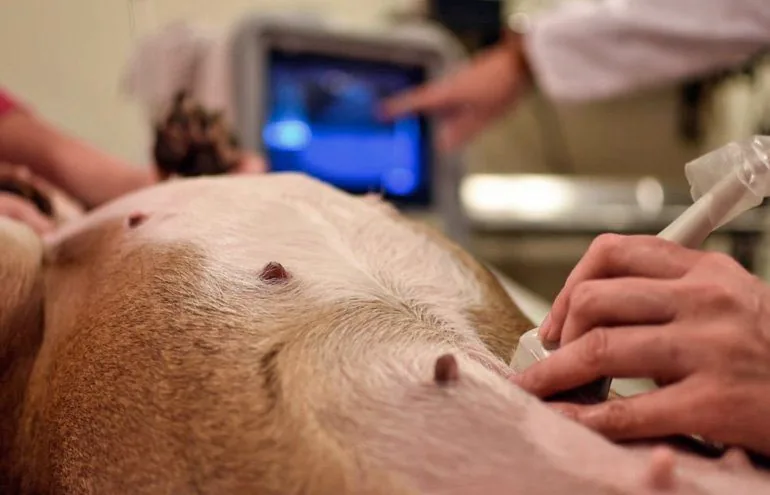
Although a C-section is a straightforward operation performed fairly often in clinics, it must be done by an experienced vet. The dog will be intubated, monitored, and anesthetized. The surgeon will cut through the different layers until reaching the uterus, from which the puppies will be quickly removed.
The umbilical cord is cut on the newborns, secretions are cleaned from their nose and mouth if needed, and they're dried off. While the procedure continues, they're moved to an incubator to keep them together and warm.
A C-section is usually a fast surgery, but complications can occur. One is bleeding. By full term, the uterus has grown considerably in size and blood supply, which could lead to hemorrhaging. The risks increase depending on the condition of the mother or the puppies.
Once the vet closes the incision, the procedure is considered complete, and after waking from anesthesia — which takes just a few minutes — the mother is moved to a spacious hospitalization cage along with her puppies. Nursing can begin from that very first moment.

When Does a Dog Need a C-Section?
Before thinking about the birth itself, we should have some basic information about that moment and about pregnancy in general. Knowing what's normal lets us quickly spot any risky situation.
A dog's pregnancy lasts roughly 60 days, after which labor begins. This usually goes smoothly and often happens at night, so we don't even notice it.
The symptoms of labor aren't always easy to spot and can go unnoticed. Sometimes we'll notice the dog stops eating, seeks shelter, or seems restless. Once labor is underway, we may notice heavy breathing, straining, or even vomiting.
During labor, the dog will have contractions that dilate the cervix and help push the puppies out. These contractions gradually intensify, but we won't always notice them. After dilation, births begin, usually spaced a few minutes apart.
If we notice the dog straining but not delivering any puppy, passing some discharge or bleeding, or seeming to have finished labor while we suspect not all the puppies have been born, we should call the vet.
Sometimes difficulties arise during a normal birth, known as dystocia. These can be due to a puppy being poorly positioned, which prevents it from coming out.
Other times the uterus fails to contract enough to complete the birth. If the vet can't resolve these cases with medication or manually, a C-section will be necessary.

When a C-Section Can Be Anticipated
Besides the cases mentioned above that can come up as complications during labor, in some dogs it's possible to plan a C-section ahead of time. This surgery is common in small dogs and in brachycephalic breeds.
This happens because breeds like the Chihuahua tend to have a single puppy that can grow larger than the mother is able to deliver. In breeds like the French Bulldog, this problem is common due to the distinctive shape of the head.
For these dogs, natural birth is very difficult, so to avoid risks, the vet will schedule pregnancy monitoring that includes X-rays. These allow measuring the first puppy's skull size against the diameter of the mother's birth canal. If the latter is smaller, a C-section will most likely be needed.
In these cases, the vet will keep a close eye on the dog during the final days of pregnancy. If labor begins, they'll examine the dog and decide whether a natural birth is possible or, on the contrary, surgery is the only option left.
Post-Operative Care After a Canine C-Section
Generally, dogs recover very quickly from the operation and are able to look after their puppies right away. We'll just need to watch the incision so it doesn't get infected or scratched by the puppies' nails. The vet will tell us when the stitches need to come out.
Warning signs include swelling in the area, redness, pain when touched, discharge, fever, or the dog refusing to eat or drink. Stitches coming loose and the wound reopening are also reasons to call the vet urgently.
IMPORTANT: This article is for informational purposes only and does not constitute veterinary, nutritional or behavioural advice. Every dog is different, and only your trusted vet can advise you on its specific needs.